
In 1892, Wellesley College President Alice Freeman Palmer proudly noted that a striking number of the College’s 734 alumnae held “conspicuous positions of responsibility.” More than a century later, the New York Times in its “Money & Business” section distilled the formula for success into three words: “Go to Wellesley.”
Now, as the College marks its 150th anniversary at a time when the value of a liberal arts education is being questioned, a new report from labor market analytics firm Lightcast and Wellesley’s Lulu Chow Wang ’66 Center for Career Education affirms what decades of anecdotal evidence has shown: Wellesley graduates rise to the top of their fields—leading companies, shaping policy, and driving meaningful change across society, regardless of their major. From technology to business, politics to scientific research, alumnae have proven the power of women’s education by excelling in industries historically dominated by men, while outpacing female graduates of peer institutions.
“It’s remarkable to watch how quickly our graduates step into leadership,” says Jen Pollard, Lulu Chow Wang ’66 Executive Director and Associate Provost for Career Education and Experiential Learning. “Students are learning to be bold and courageous, and to be at the table in productive ways right from the moment they arrive at Wellesley.”
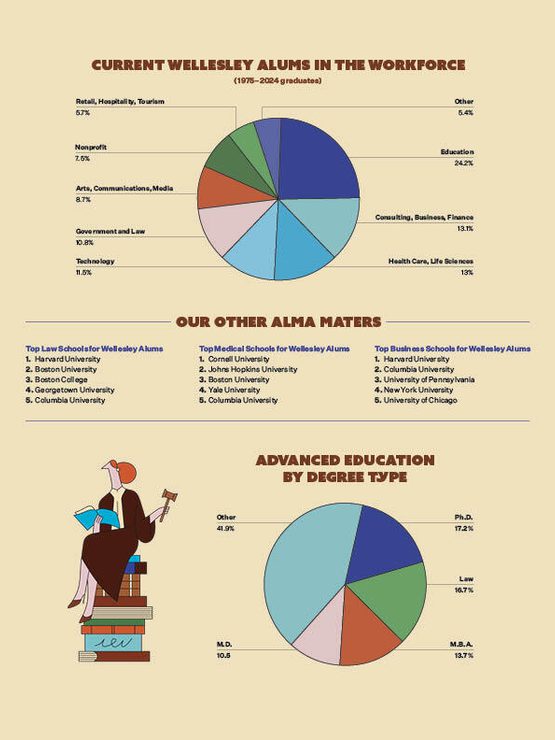
The report shows that the more than 26,000 Wellesley alumnae from the classes of 1975 to 2024 currently in the workforce are better represented at Fortune 500 firms than their peers at other women’s colleges and selective institutions like Amherst, Middlebury, and Swarthmore. They’re writers, doctors, entrepreneurs, educators, and scientists who achieve management-level positions rapidly and at higher rates.
By 15 years post-graduation, over 40% of alumnae have ascended to management roles, most commonly chief executive officer, president, or executive director. These leaders studied across a wide range of disciplines: 10% of all humanities majors rose to the level of CEO, 11% of social science majors, and 5% of STEM majors. More than 200 Wellesley graduates are partners at law firms, while more than 500 have launched their own businesses. Alumnae are 17% better represented in government positions such as judge and policy advisor than graduates of other highly selective private liberal arts colleges. And they’re more likely than their peers to be chosen as board members, sought after for their strategic thinking and leadership skills.
The passion for learning instilled at Wellesley drives graduates to pursue advanced degrees, including doctorates, at high rates, too. Nearly 60% of alumnae have pursued advanced degrees at the master’s level or above, according to the report. Some 17% of those who pursued advanced degrees studied law, 14% business administration, and 11% medicine.
Meanwhile, Wellesley continues to send recent graduates into the workforce on sure footing. Six months after graduation, 97% of the class of 2024 (compared to the national average of 85%) were employed, accepted to graduate school, or participating in a service/volunteer program.
More than ever, a Wellesley education prepares graduates to lead in a rapidly changing world, says Pollard. “It prepares you to be resilient and make the most of the opportunities as they come up. That’s where we see leadership soar. Our alumnae know how to navigate moments of change and innovation because they’re set up to learn.”
We spoke with five alumnae with varied career paths about their journeys and Wellesley roots.
Capital with a Civic Mission
In 2020, after years of working as a data scientist for high-growth software companies in Silicon Valley including Dropbox, Christine Keung ’14 sat in her Harvard Business School dorm frustrated that small businesses weren’t getting needed funds. Friends and family—including her small-business owner aunt and uncle—couldn’t get their Paycheck Protection Program (PPP) loans, created to support businesses during the pandemic, in part due to inefficient government technology and unequal access to banking.
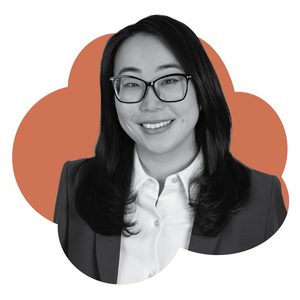
After earning her M.B.A., Keung accepted an appointment with the Trump administration on the Small Business Administration’s COVID-19 task force. She worked with financial technology companies such as PayPal to process PPP loans at scale, expediting payments for millions of Americans. She also led outreach to encourage minorities to pursue loans. “I’m so proud and passionate about this period of my life,” she says.
Later, as chief data officer for the city of San Jose, Calif., Keung helped the mayor use data to make decisions that led to more equitable delivery of services. Then she decided to combine her tech background, government experience, and connection to the world of venture capital to do good.
In 2022, Keung joined a business school friend to raise a $150 million venture fund that backs new technologies useful for both national security and everyday business. With over $300 million in assets under management, J2 Ventures backs early-stage technology startups developing solutions that help the government operate more efficiently—and benefit society.
Women remain significantly underrepresented in venture capital—only 19% of investment partners are women. “I want more deep-tech VCs to look like me, to see more founders that reflect the diversity of this country,” Keung says.
Keung sits on boards of the startups she invests in, too, shaping solutions. With the firm’s support, startups including Boston-based Lumia Health, which makes an in-ear wearable device that measures cerebral blood flow to the brain, and San Francisco-based Oura, which makes a ring that tracks metrics like sleep and exercise, secured millions through government grants and contracts.
Keung was the first in her family to attend college. She came to campus from El Monte, Calif., where growing up she peeled shrimp, waited tables, and balanced the books at her parents’ Chinese restaurant. She studied economics and was an Albright Fellow. Time spent with former Secretary of State Madeleine Korbel Albright ’59 taught her to embrace change and be unafraid to blaze new trails.
“Wellesley gave me the courage to be curious about who I could be, and the license to take risks,” Keung says.
Tuning In to Global Audiences
Anna Rios ’01 has helped media giants including NBCUniversal, Disney, and Univision crack the code on what makes audiences laugh, cry—or change the channel.

Through in-depth interviews, surveys, and focus groups, she’s shaped the development of hits like Grey’s Anatomy, Keeping Up with the Kardashians, and The Real Housewives. Her research drove a high-stakes creative decision for one show—to reveal in the trailer that three quirky, seemingly unrelated households were actually one big, dysfunctional extended family—and set the tone for that series.
Now, as head of consumer insights for Latin America, Canada, Australia, and New Zealand at Prime Video and Amazon MGM Studios, Rios helps the company understand its audience, measuring how plotlines and characters resonate, from first concept, to rough cuts, to final edits. She brings stories from São Paulo, Santiago, and Sydney to life.
Recently, Rios gauged how viewers would respond to the Mexican comedy-drama Mentiras, La Serie, an adaptation of a stage musical featuring 1980s Mexican hits. Generations loved the songs, but it wasn’t clear whether a musical format would connect with today’s audiences. Rios thought it would. She was right. After the series’ release, its soundtrack debuted on Spotify’s Top 10 albums worldwide list. “Nostalgia will always be a big hit,” she says.
TV trends come and go, adds Rios. But as audiences have become more global, one truth remains: A powerful story entertains, teaches, inspires, and even unites people. It’s what she and her team strive to achieve every day. “What moves us is the humanity,” she says.
Raised in East Los Angeles, Rios at age 6 told her single mother that when she grew up, she wanted to wear heels, carry a briefcase, and go to work. She “fell into Hollywood” when she left a position on Wall Street for home a month after 9/11. A Wellesley connection led to a job at Univision. “That got me in the door,” she says. In Hollywood, the blending of data and storytelling in research jobs appealed to her.
Her liberal arts education at Wellesley, where she studied religion and Spanish literature, helped her rise steadily through the corporate ranks. “I wasn’t born into boardrooms,” says Rios, who was a first-generation college student. “I had to learn to navigate them.”
Wellesley taught her to ask bold questions, respectfully debate, and lead, even when she was the only woman—and often, only Latina—in the room. Rios left the College with emotional intelligence and strong female relationships she carries to this day. In life and work, “it always goes back to the human connection,” Rios says. “What is it to be human? What connects us? And then, everything else is just a backdrop.”
Contraception, Education, and Impact in the Philippines
On the remote Philippine island of Palawan, where rugged jungle mountains roll to white sand beaches, one of seven pregnancies in the last decade has been a teen pregnancy. In the same area, HIV cases surged 411% between 2012 and 2023.
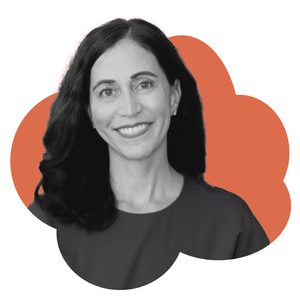
Amina “Ami” Evangelista Swanepoel ’02 returned home to Palawan in 2009 with her husband to partner with her mother, a teacher, on a solution. The three set out to reduce unplanned teen pregnancy, maternal deaths, and HIV—and they have.
Her nonprofit, Roots of Health, helped slash the teen pregnancy rate in Palawan’s capital of Puerto Princesa City by 60%. In its first year, Roots of Health provided nearly 100 women with their contraception of choice. Last year, it was 17,000. Her work has included tireless negotiations with the Catholic country’s government, which gave her the green light to teach comprehensive sex education in Palawan public schools for the first time.
“There are so many girls who start having babies when they’re 13 or 14,” Swanepoel says. “And there’s a large percentage of those girls who, even after the first pregnancy, aren’t connected to services. So, it’s like a double failing.”
Swanepoel’s interest in human rights was piqued at Wellesley, where she gravitated to political science and peace and justice courses. An early role at Human Rights Watch in New York supporting researchers in Asia was “a dream come true,” she says. When a colleague launched an HIV-related access-to-condoms project in the Philippines, she tagged along. Then she earned degrees from Columbia in international affairs and public health just before the 2008 global economic crisis.
After a long job search, Swanepoel left an unfulfilling entry-level position to return to the Philippines, where her mother watched her Palawan State University students drop out due to unplanned pregnancies. The two taught students comprehensive sex ed and drummed up interest in a community class.
They have since launched the Young Couples Communication Program, which teaches teen couples about effective communication and consent. Now, Swanepoel is leading efforts to scale solutions across the Philippines, where teen pregnancy rates remain high. “There’s still lots of work to be done in equipping young people with the information they need,” she says. “The ability for a girl or woman to control her body and decide if or when to have a pregnancy has such a huge impact on the rest of her life.”
Floss Boss
Four years out of dental school, Chrystle Cu ’05 had a thriving Silicon Valley dental practice and a monthslong waitlist, but she felt defeated. Over half of patients’ cavities were in between teeth, preventable with regular flossing. She couldn’t keep up, and needed a reset. Cu left California for a village in Eastern Peru for a week of dental volunteer work.

At a school with no running water and lawn chairs for dental seats, she treated Quechua-speaking parents with gum disease and children with decaying teeth who cried because it hurt to eat. “It’s very hard to see this,” she says. “Devastating, depressing.”
But Cu felt good about the work. “It hammered home for me that education is the most important piece. Everybody is affected by gum disease, no matter if you’re the farmer in Peru, or the CEO in Silicon Valley,” she says.
Back home, she set out to transform how people feel about oral care, tackling flossing first. “Flossing really needed a makeover,” she says. “It needed to work better and be a brand people loved to use. I became obsessed with trying to solve this problem in an unexpected way.”
In 2015, alongside her younger sister Cat Cu, she launched Cocofloss, a woven dental floss infused with coconut oil designed to pick up plaque. The product stood out from competitors with its surprising flavors, like orange and coconut, and colorful packaging. Now, the sisters are co-CEOs of Cocolab, their expanded eco-conscious company, which makes a toothpaste and toothbrush designed by Cu, too. In August, Inc. 5000 listed Cocolab as one of the fastest-growing companies in America, with 177% three-year growth. Products are available in two-thirds of CVS stores and on Target.com.
Cu’s mother is a dentist, so she was immersed in dentistry from an early age. But in high school, she disliked AP chemistry, making a future in dentistry seem unlikely. Then, at Wellesley, she thrived in an intro chemistry class. “The light bulb went on for me,” she says. “I just fell in love with chemistry because of Chris Arumainayagam’s class.” So much so that she majored in it.
She co-founded Wellesley’s Pre-Dental Society, organizing outings to Natick and Framingham elementary schools to teach students how to care for their teeth. Rebranding Wellesley’s GenerAsians Magazine and assembling a strong team as editor gave her an early taste of building a company. And after sharing Cocofloss in Wellesley’s Community Facebook group, students and alumnae were among her company’s earliest adopters. “Wellesley has been so supportive,” Cu says, “and I’m so grateful.”
Schooling the System
When Jacqueline Sánchez ’19 was growing up, education was a regular topic at the family dinner table. Both her parents taught eighth grade social studies in New Mexico’s public schools, and two of her grandparents were teachers, too. But Sánchez wasn’t interested in becoming an educator, or even in moving back home.

Instead, after studying English and history at Wellesley, she took a job as a legal assistant at a Boston law firm. But her heart wasn’t in it. “I didn’t feel like I was helping people,” Sánchez says. She took time to reflect on next steps, realizing she wanted to brainstorm what goes into laws, not work with them after the fact. “And I wanted to help New Mexicans,” says Sánchez. “I wanted to help the people I had been raised with.”
In 2022, Sánchez moved to Santa Fe to join the New Mexico Public Education Department as legislative liaison, a role that entails meeting with legislators and legislative staff from across the aisles to advocate for critical school funding, and helping shape policy. New Mexico has the highest percentage of Hispanic/Latino students in the U.S., and its public schools struggle with low attendance and graduation rates. In 2024, Sánchez became the department’s acting deputy director, leading a team of policy analysts, and she is also pursuing a master’s degree in public administration at Wake Forest University.
In the 2023 state legislative session, Sánchez worked to pass a nearly $5 billion budget for New Mexico’s public schools. She also supported a bill for free breakfast and lunch for all public school students, and another bill that provides free menstrual products. “Public education is the cornerstone of democracy,” Sánchez says. “If we funded education systems a quarter as well as we fund our defense systems, we would change the fabric of this nation.”
In New Mexico, some stakeholders are laser-focused on raising student proficiency rates, but Sánchez believes it’s important to prioritize creating a successful educational environment where children have a highly qualified educator in the classroom, get enough food to eat, and feel safe at school. Proficiency rates will follow, she says.
Being surrounded by so many intelligent women at Wellesley was a call to action of sorts, she says. “Being smart is really only a starting place.” More important is what you do with your abilities. “Wellesley was definitely one of the most impactful experiences I’ve ever had,” she says. “It empowered me to not just be a bystander in my own life, but to take charge, stand up, and do something about the problems I see in the world.”
Deborah Lynn Blumberg ’00 is a freelance writer specializing in business, finance, and health, and the president of the Washington, D.C., chapter of the American Society of Journalists and Authors.
Post a Comment
We ask that those who engage in Wellesley magazine's online community act with honesty, integrity, and respect. (Remember the honor code, alums?) We reserve the right to remove comments by impersonators or comments that are not civil and relevant to the subject at hand. By posting here, you are permitting Wellesley magazine to edit and republish your comment in all media. Please remember that all posts are public.