
In August, Claudia Joskowicz, a video artist and associate professor of art at Wellesley, found herself in a bind. She was supposed to be wrapping up shooting on a new project set in Bolivia’s Andean salt flats. Instead, she was grounded on the opposite side of the country—without any footage to show for her efforts. On the eve of national elections, Bolivia faced a nationwide gas crisis, and the production bill for her project suddenly quintupled. “This is why my work takes forever,” she explains by phone from her hometown of Santa Cruz de la Sierra. “It’s like a feature-length film. I work with the same production crews, and we have to get the same permits. It’s just that my film is only minutes long.” As often happens in her career, she had to make a quick pivot and get creative.
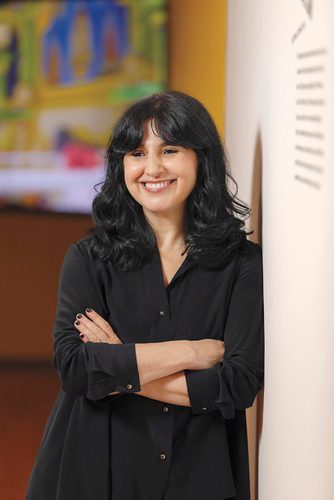
Joskowicz is in the midst of a multiyear project, How to Read a (), which will result in nine short films shot in each of Bolivia’s nine departments, or administrative regions. Bolivia is vast and ethnically and geographically diverse, and it has also experienced rapid—and uneven—development over the past 20 years, many of them under the leadership of its controversial former president, Evo Morales. Joskowicz envisions each film reproducing a mythical or historical moment specific to the location, and she plans for them to be installed together, so that viewers can explore the connections—and disconnections—of the collected scenes.
One completed piece of the project is on exhibit at Wellesley’s Davis Museum through May 24, 2026. Parallels is a two-channel video installation depicting an Indigenous, all-female wrestling match as well as its audience of foreign tourists and white Bolivians. It was filmed in El Alto, high in the Andean plateau, inside one of the striking cholets (a portmanteau of cholo and chalet) that have sprung up in the booming city, an example of a hyperlocal neo-Andean architecture.
Joskowicz was fascinated by how the wrestling match, the audience, and the architecture highlight the country’s many contradictions. For instance, while the cholets were inspired by Indigenous designs, they emerged during a period of immense wealth accumulation in the city, largely influenced by global trade with China and Russia, whose visual aesthetics now permeate and shape El Alto’s contemporary urban culture. Likewise, the wrestling matches grew out of the women’s desire to learn self defense due to high levels of domestic violence within their communities, yet the performers are often quite young—still minors. “In one way, it does empower these women to make a living,” says Joskowicz, acknowledging that the woman who created the wrestling show was awarded an international prize for feminism. “But it’s also a spectacle, a tourist draw, that from a feminist perspective is very problematic,” she says.
“For me, the landscape and the built environment are main characters, and my work often involves reimagined cinematic stagings where a nuanced political drama unfolds.”
Joskowicz, who holds a bachelor’s degree in architecture, grew up in Bolivia during the 1970s and ’80s, a tumultuous period marked by military dictatorships. She is the daughter of a Bolivian mother and a Jewish refugee father from Poland, and her artistic practice often reflects her nontraditional upbringing. “For me, the landscape and the built environment are main characters, and my work often involves reimagined cinematic stagings where a nuanced political drama unfolds,” she says. She has an extensive record of international exhibitions and fellowship awards, and her work has twice been acquired by the Guggenheim Museum. A monograph, Stillness in Motion (Turner), was published in Spain in 2024 and in the U.S. this past summer.
A professor at Wellesley since 2017, Joskowicz teaches the art department’s three-course sequence in video and film production and enjoys her students’ ambition and creativity. She has supervised theses ranging from a modern lesbian rom-com to a video installation about sociopolitical changes in Venezuela. She says she encourages her students “to explore their own interests and experiment beyond their comfort zones, understanding that in the creative process, failure is sometimes a necessary step.”
This past summer, she followed her own advice, turning a season’s worth of setbacks into ultimate success. After our interview, she headed in a new direction, both literally and figuratively: She traveled to the Chiquitanía tropical forests to shoot another film she had planned for the series—and wrapped just in time to return to campus for the start of classes.
Celebrating Faculty Artists
Coinciding with the College’s 150th anniversary, the Davis Museum is hosting an exhibition of work by faculty artists, through May 24, 2026. In Focus: Wellesley College Faculty Artists features works across various media, including photography, painting, collage, sculpture, book arts, printmaking, installation, video, and sound. In addition to Claudia Joskowicz’s video installation, Parallels (see above), the show includes work by Kathryn Abarbanel, Genevieve Cohn, Kathya Landeros, Phyllis McGibbon, Andrew Mowbray, Daniela Rivera, Katherine Ruffin, and David Teng Olsen.
Since the Davis opened in 1993, it has hosted a group exhibition of faculty artists about every five years. “They exhibit all around the world, and we want for our community to be able to appreciate—and celebrate!—their brilliance right here at home,” says Amanda Gilvin, interim co-director and Sonja Novak Koerner ’51 Senior Curator of Collections and associate director of curatorial affairs.
The Davis has additional exhibitions planned to coincide with the College’s anniversary. Digging into History: The Wellesley College Hall Archeology Project, explores the rich history of College Hall (see page 8). Suzanne Ciani: Sound Lounge, features the soundscapes of multi-Grammy-nominated composer Suzanne Ciani ’68. Only To Be There, which opens in February, highlights a wide range of Wellesley traditions with objects and photographs from the Wellesley College Archives.
Post a Comment
We ask that those who engage in Wellesley magazine's online community act with honesty, integrity, and respect. (Remember the honor code, alums?) We reserve the right to remove comments by impersonators or comments that are not civil and relevant to the subject at hand. By posting here, you are permitting Wellesley magazine to edit and republish your comment in all media. Please remember that all posts are public.