
A hunk of metal—technically, part of a hold-down stud frangible nut—from mission STS-120 is affixed to a plaque in the office of retired U.S. Air Force Col. Pam Melroy ’83 at NASA headquarters. During the historic 2007 mission the nut commemorates, Melroy became only the second woman to command a space shuttle mission. Discovery launched from Kennedy Space Center on a 15-day, 6.2 million-mile voyage to the International Space Station—Melroy’s third trip there—to deliver an Italian-built U.S. module. While there, she and her team also carried out an unplanned spacewalk to repair a damaged solar array.
Melroy has since hung up her flight suit, and in 2021, she took on the role of a lifetime as NASA’s deputy administrator. She is now shepherding a reimagined agency through a groundbreaking era of space exploration. The space shuttle (and its frangible nuts) are relics of the past. Today, NASA encourages commercial space travel, unifies the world around ground rules for new frontiers, and pioneers medical, climate, and other scientific research.
Like many Americans, Melroy was inspired by the 1969 Apollo 11 mission, which landed the first people on the moon. At Wellesley, she majored in astronomy and physics and completed the U.S. Air Force Reserve Officers’ Training Corps (ROTC) program. She was commissioned to the Air Force once she graduated, and after earning an M.Sc. in Earth and planetary sciences from MIT in 1984, she was one of only a few women in her pilot training class at Reese Air Force Base in Texas. She became a copilot, aircraft commander, instructor pilot, and test pilot, and served in Operation Desert Shield/Desert Storm and Operation Just Cause. By the time Melroy retired from the Air Force in 2007, she had logged more than 6,000 flight hours.
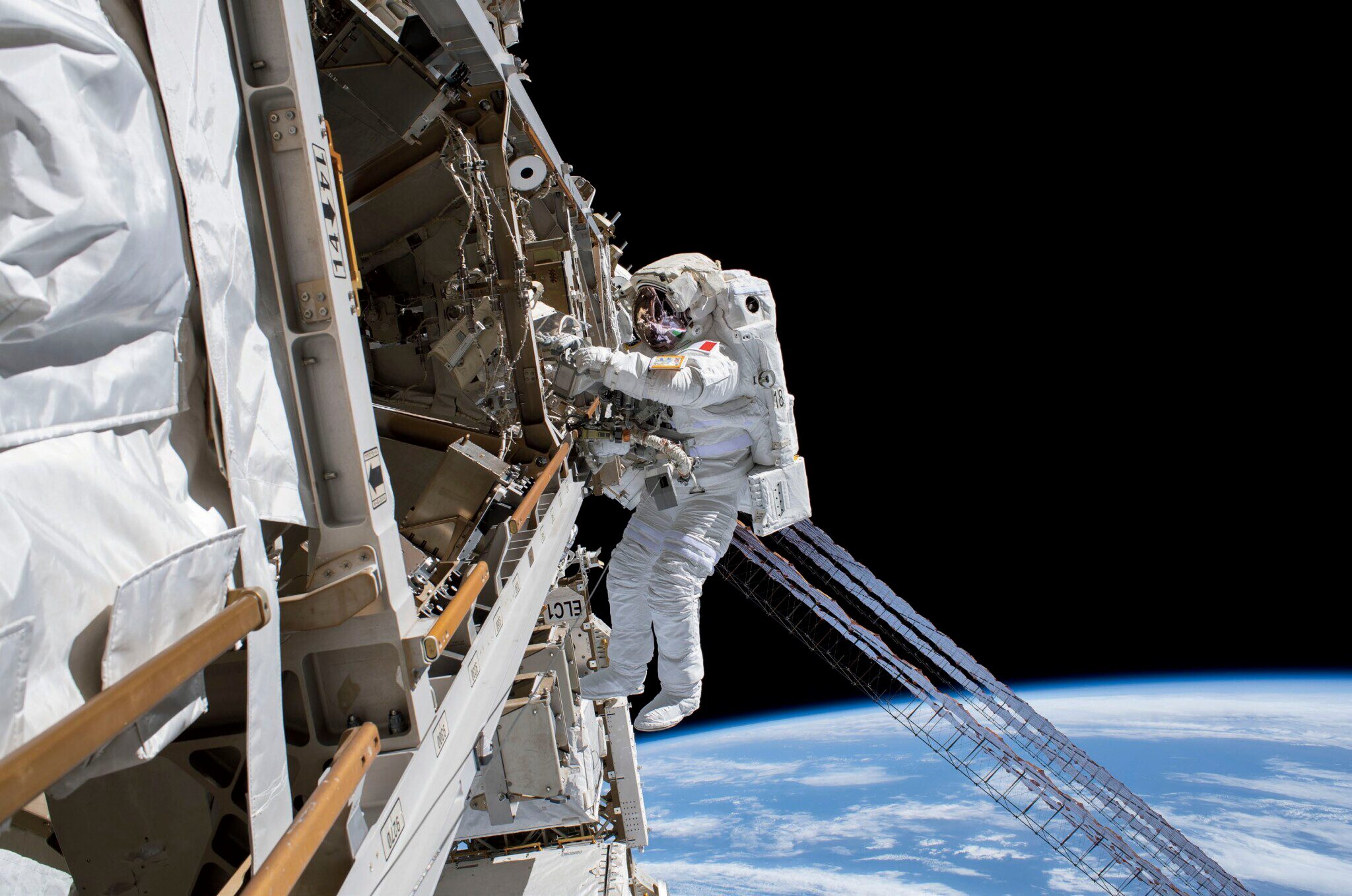
Her flight and leadership experience led to her selection as an astronaut candidate in December 1994. In 2000 and 2002, she piloted space shuttle missions STS-92 and STS-112 to the International Space Station, before her third and final mission as commander. She has received numerous honors, including the Air Force Meritorious Service Medal and Wellesley’s Alumnae Achievement Award.
After those three successful missions totaling more than 38 days in space, Melroy decided to broaden her horizons. In 2011, after 30 years, NASA ended its shuttle program following the landing of Atlantis. “I spent so much of my life trying to prepare myself to be an astronaut, and then to compete and then be selected and then, of course, to go do it,” she says. “As amazing as it was to go to space, I knew the shuttle program was going to retire, I knew that the flight opportunities would pass. I felt that I really needed to go explore some different things.”
She realized that first she needed to get experience in the financials of space—and that meant shifting her orbit, moving from NASA and the shuttle program into industry. She wanted to learn, she says, “Why does it cost so much to build a spacecraft? Where’s the hard part? What takes a long time?” She also wanted to better understand the legal and policy implications that came with the emerging commercial space sector. She took on leadership roles at Lockheed Martin, the Federal Aviation Administration, and the Defense Advanced Research Projects Agency (DARPA), which has developed pivotal national security technologies.
“The whole experience really was about climbing new mountains and learning new things,” Melroy says. Still, she says she never expected a call like the one she got to return to NASA as deputy administrator: “I didn’t see this one coming.”
“The day I walked out of the door at Wellesley and someone told me women weren’t good at math and science—I was like, ‘Every physics major I knew was a woman. And believe me, I was not the smartest one.’”
Pam Melroy ’83, NASA deputy administrator
Commercial space
Today’s NASA is a different world than the one Melroy joined as an astronaut in the 1990s. Notably, the agency has fully embraced commercial space travel, to the surprise of some. In fact, Melroy says, NASA helped seed the commercial space industry over a decade ago when it started to pay commercial partners to deliver cargo to the International Space Station. “There were a lot of people who thought we were crazy,” she says, “that you always needed governments to have the kind of oversight and responsibility for tech development like that. But it was … so successful that a commercial crew was the next step.”
These days, private space companies—Elon Musk’s SpaceX and Jeff Bezos’s Blue Origin included—are upending the old model for space exploration, aiming to dramatically reduce its cost and increase access to space. Melroy and NASA have leaned into that shift, becoming partners with these companies. Commercial partnerships allow the companies to build and operate their own systems while enabling NASA to further its science and research ambitions, Melroy says.
The groups are already reaching new horizons—in 2020, the first crewed flight on a commercial vehicle, SpaceX Crew-1, arrived at the International Space Station. So far, commercial seats for tourists have come at a hefty price—in 2021, Blue Origin auctioned a seat on its first crewed flight for $28 million, and as of February, Virgin Galactic tickets were priced at $600,000.
Though these partnerships may seem at odds with NASA’s original mandate to extend the United States’ presence in space as a nation, Melroy sees them as positive. NASA still provides technical and development help, she says, and any joint projects must meet the agency’s standards. In these early days of commercial human spaceflight, NASA is deeply involved with its partners, transferring its knowledge—and its core value of safety. Melroy says these relationships bring the costs down for the agency and, ultimately, are already making space more accessible. “It has been transformative,” she says. “Low-cost access to space, low-cost satellites—the things that are happening in the commercial market today are incredible.”
NASA has work under contract with both SpaceX and Blue Origin to develop human landing systems for missions to the moon, hoping that the competition will inspire innovation. It even has partners working on developing commercial space stations to follow the ISS.
Why invest in space?
Since NASA was created in 1958, it has had to defend government investment in space programs when there are so many pressing problems here on Earth. But Melroy argues passionately that the work is worth doing for the benefit of the U.S. and the world. Space exploration, she says, contributes enormously to the advancement of science and medicine as well as the nation’s economy.
Melroy cites as an example her own experience flying in microgravity. “When you take gravity away, all of a sudden, you see biological and physical processes that you can’t see here on Earth,” she says. “For example, you’re dehydrated once you adapt to space. So why don’t we see more kidney stones?” Studying how the body works in space could help us understand how to better prevent things like kidney stones in the future.
NASA is also covering new ground in climate science with its Plankton, Aerosol, Cloud, ocean Ecosystem (PACE) satellite. In February, PACE launched aboard a SpaceX Falcon 9 rocket with a mission to study how the ocean and atmosphere exchange carbon dioxide. Though the closer-to-home focus may seem different than the shuttle missions of Melroy’s days, she says it’s a perfect fit for the agency because NASA already knows how to conduct planet-scale research. “It would be impossible to instrument the Earth, across its entire surface. … The best way to actually know what’s going on with the Earth is from space, because you can get that scale,” she says.
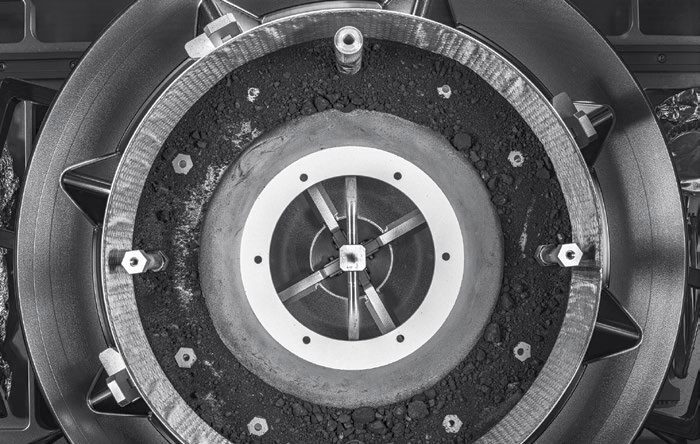
Exploring space, Melroy says, can also have an enormous impact on technology and the economy here on Earth. “My favorite example is that software engineering didn’t exist as a term or a discipline until Apollo,” Melroy says. “It also set the United States up to lead the way in the development of the internet, which obviously had a huge economic impact on the U.S. and the rest of the world.”
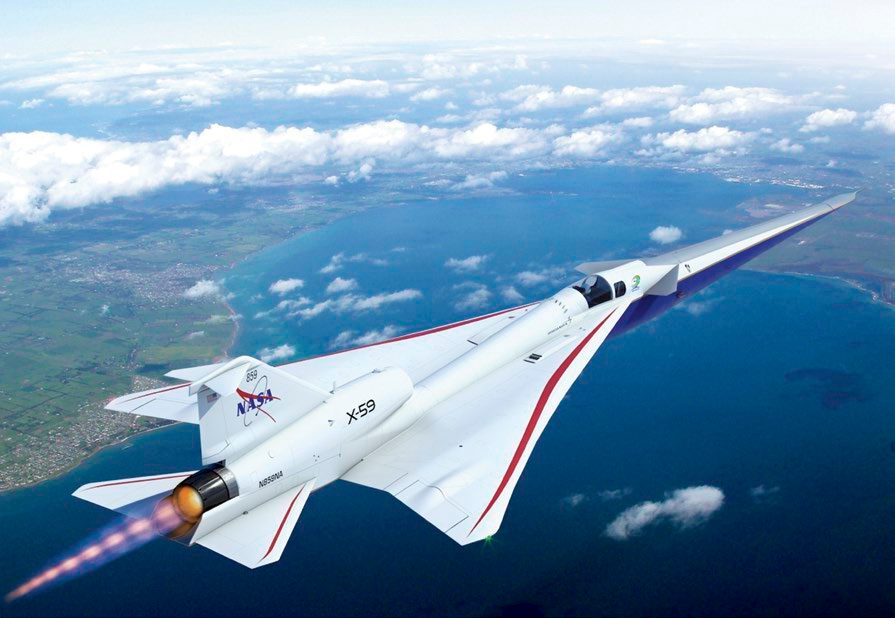
In January NASA, along with Lockheed Martin, unveiled the X-59 plane, a quiet, supersonic, 99.7-foot aircraft that’s sleek with a long, pointed nose. It can travel at 1.4 times the speed of sound, or 925 mph.
Supersonic airplanes have been outlawed in the U.S. and other nations because they produce sonic booms and tremors. The X-59 produces a quieter “sonic thump.” It’s still experimental, but with its speed and relative quietness, it has the potential to supercharge air travel.
“When we do hard things—and these are hard things—we solve problems [whose solutions] have multiple uses and they create a science and technology capability in our country that we can apply to other problems,” Melroy says.
Melroy also sees a continuing role for NASA in developing projects that do not yet have a commercial business model—the complicated task of getting more humans on the surface of the moon, for example. “What we see is that we need to just move as rapidly as possible through that technical development, solve the problem, and then transfer the technology to industry so that they can create new business models out of it,” she says. “So our job is to stay at the cutting edge."
Inspiring the human spirit
Melroy adds that beyond the economic and scientific benefits, exploring space is simply inspiring. “I usually don’t have to talk too much about that,” she says, “because people get excited”—especially new generations that will go on to make their own advances.
To encourage the next generation, NASA has donated $5 million to seven women’s colleges to research and develop strategies that increase retention of women in STEM degree programs and careers.
Melroy is committed to bringing diverse voices into space programs because, at every step of her career, she was one of very few women doing what she was doing. She credits Wellesley with giving her a lot of her confidence.
“The day I walked out of the door at Wellesley and someone told me women weren’t good at math and science—I was like, ‘Every physics major I knew was a woman. And believe me, I was not the smartest one,’” Melroy says. “You just know, in your heart, that women have so much to offer. I think I’ve definitely carried that with me—it’s just a given to find ways to make sure that everybody gets a fair shake at it.”
Wellesley also showed her how to solve problems in an interdisciplinary way. Setting norms of behavior on the moon, she says, has a technology piece, but it also requires thinking through different cultural perspectives and understanding how policy works.
Now, Melroy says, the emergence of commercial space travel has invigorated a new generation. “It’s a different NASA now than [the one seen by] the people who grew up watching the moon landing and went on to become astronauts. And that was me, right?” The Artemis missions will send the first woman and the first person of color beyond Earth’s orbit and eventually to land on the moon’s surface. When this happens, “I do think there will be a tidal wave of interest in this area,” Melroy says.
“When we do hard things—and these are hard things—we solve problems [whose solutions] have multiple uses and they create a science and technology capability in our country that we can apply to other problems.”
Pam Melroy ’83, NASA deputy administrator
“We consider it part of our mission to ensure we have a diversity of thought inside our agency, but also in our partners. We’re doing things no one’s done before. And I can give you countless examples of where one person on the team … brought a different perspective and was able to solve a problem. It happened all the time up in space, by the way,” she says.
“I think space does have the power to inspire the human spirit,” Melroy says. “When you look at a picture from the James Webb Space Telescope, that’s 13 billion years back in time, and the insights we’re getting out of that, just even the visual artistic picture, is an inspiration. Especially being in microgravity, it’s like being magic. I mean, who doesn’t wish that they could float or fly?”
Amita Parashar Kelly ’06 is a supervising producer at NBC News who dressed as an astronaut for her kindergarten Halloween parade.
From Wellesley to the Stars
Many alums whose passion for space exploration was nurtured in Wellesley’s Whitin Observatory have gone on to push the boundaries of human knowledge about space at observatories, universities, NASA, and scientific laboratories. We spoke with a few young alums in the field about their work and their hopes for the future. —APK

Anicia Arredondo ’16
Southwest Research Institute
An observational astronomer, Arredondo uses telescopes to collect data. Studying asteroids, she says, gives us information about what the solar system was like when it was forming 4.5 billion years ago. In a groundbreaking discovery, Arredondo and her team recently detected water on two asteroids for the first time ever. Finding signatures of water on asteroids, she says, can help explain how water could potentially get to other planets.
She caught the “observing bug” at Wellesley, where she conducted real research using its research-grade telescope. “That opened doors for me to be able to apply for summer research internships,” she says. “The rest is history!” She now uses the James Webb Space Telescope in her work—the most powerful space telescope ever built.
She’s enthusiastic about how global space exploration is becoming, noting that Canada built an arm for the International Space Station, Japan retrieved samples from asteroids, and India has landed a rover on the moon. “Scientific advancement happens when people of all nations can collaborate,” she says, “so I’m very excited to see new space programs being started, and I hope to get to work with some of them someday.”

Abigail Harrison ’19
Queen’s University, Facility for Biogeochemical Research on Environmental Change and the Cryosphere/Founder and former president, the Mars Generation
A passionate science communicator, Harrison is known as “Astronaut Abby” on social media, where she shares tips, like this one ahead of the Perseid meteor shower: “This weekend is the perfect time to get outside and LOOK UP.”
She has wanted to go to space since age 4, and at 11 she wrote a plan for becoming the first astronaut to set foot on Mars.
At Wellesley, Harrison founded the Mars Generation, which educates young people about the importance of space exploration and STEM. The organization has reached tens of millions of people with digital science content, a student leadership program, and STEM experiences for young people from economically disadvantaged backgrounds.
Her book, Dream Big!: How to Reach for Your Stars, aims to help others achieve big dreams.
Now a graduate student at Queen’s, Harrison is conducting environmental degradation research, and she’s well on her way to achieving her ultimate dream of becoming a NASA astronaut, having earned her private pilot certificate and other certifications.
As important as the Apollo years were, she says, we are now in the “golden age” of space exploration. “The burgeoning commercial space industry has the potential to revolutionize space exploration,” she says.

Shreya Parjan ’21
Artificial Intelligence Group, NASA Jet Propulsion Laboratory
A data scientist at NASA’s famed Jet Propulsion Laboratory, Parjan works on the On Board Planner, which she describes as a “new, autonomous capability for the Perseverance rover that lets it do some decision-making for itself.” So far, Mars rovers have needed human operators to give them strict instructions on what to do. Now, Parjan says, the planner can schedule and adjust when Perseverance’s activities take place.
“As a verification and validation engineer, I ensure that the autonomous flight software meets its design requirements and preserves the rover’s safety in the dynamic Martian environment,” Parjan says. Her role is critical to ensuring that operators and scientists trust the software’s decision-making capabilities.
She credits Wellesley with challenging her to “explore the relationship between theory and practice,” and for emphasizing community in learning.
“In space exploration, every aspect of translating a scientific proposal from idea to operational in flight depends on the collaboration of people from all different disciplines and backgrounds,” she says.
Parjan is encouraged by the role autonomy will play in helping spacecraft make more complex decisions by deciding where to collect samples, how to analyze them, and what type of data to report back to operators when possible.

Eunice Beato ’23
Department of Physics, Yale University
Beato is working toward a physics Ph.D. and has a background in astronomy research and an interest in dark matter. She wants to continue learning about things “much bigger than us as humans.”
She’s excited to see how much more we can learn about space but hopes that as humans venture further, “we are conscious of our history on Earth and are intentional about being curious and answering questions we have, but not conquering space and monetizing it.”
Wellesley’s Whitin Observatory was a major source of motivation for Beato. “Being able to operate a telescope and capture pictures of galaxies and identify exoplanets was so inspiring,” she says. “I felt like I was actually contributing to science and was a part of a much larger history of women in astronomy and physics who have found solace in exploring space and asking questions about the mysteries of the vast universe around us.”
Wellesley, she says, gave her a sense of community and curiosity. “I have seen first-hand the impact that [community] has, so I will continue to pay it forward by intentionally creating community in every physics and astronomy environment that I am in.”


Post a Comment
We ask that those who engage in Wellesley magazine's online community act with honesty, integrity, and respect. (Remember the honor code, alums?) We reserve the right to remove comments by impersonators or comments that are not civil and relevant to the subject at hand. By posting here, you are permitting Wellesley magazine to edit and republish your comment in all media. Please remember that all posts are public.