
Curious Personage by Judith Rothschild ’43 was painted by the artist just a few years after she graduated from Wellesley. Rothschild arrived at the College already dedicated to her studio practice; she continued to paint, majored in art history, and served as an art critic for the Wellesley News. After commencement, she moved to New York City and quickly became involved in a dynamic downtown art scene committed to developing abstraction as a force in modern art. In 1945, she became a member of the short-lived but influential Jane Street Gallery, which ran the first artists’ cooperative gallery in New York. A solo show in its space in December 1945 garnered positive attention and an invitation to join the prestigious American Abstract Artists organization, of which Rothschild would eventually serve as president in the 1970s.
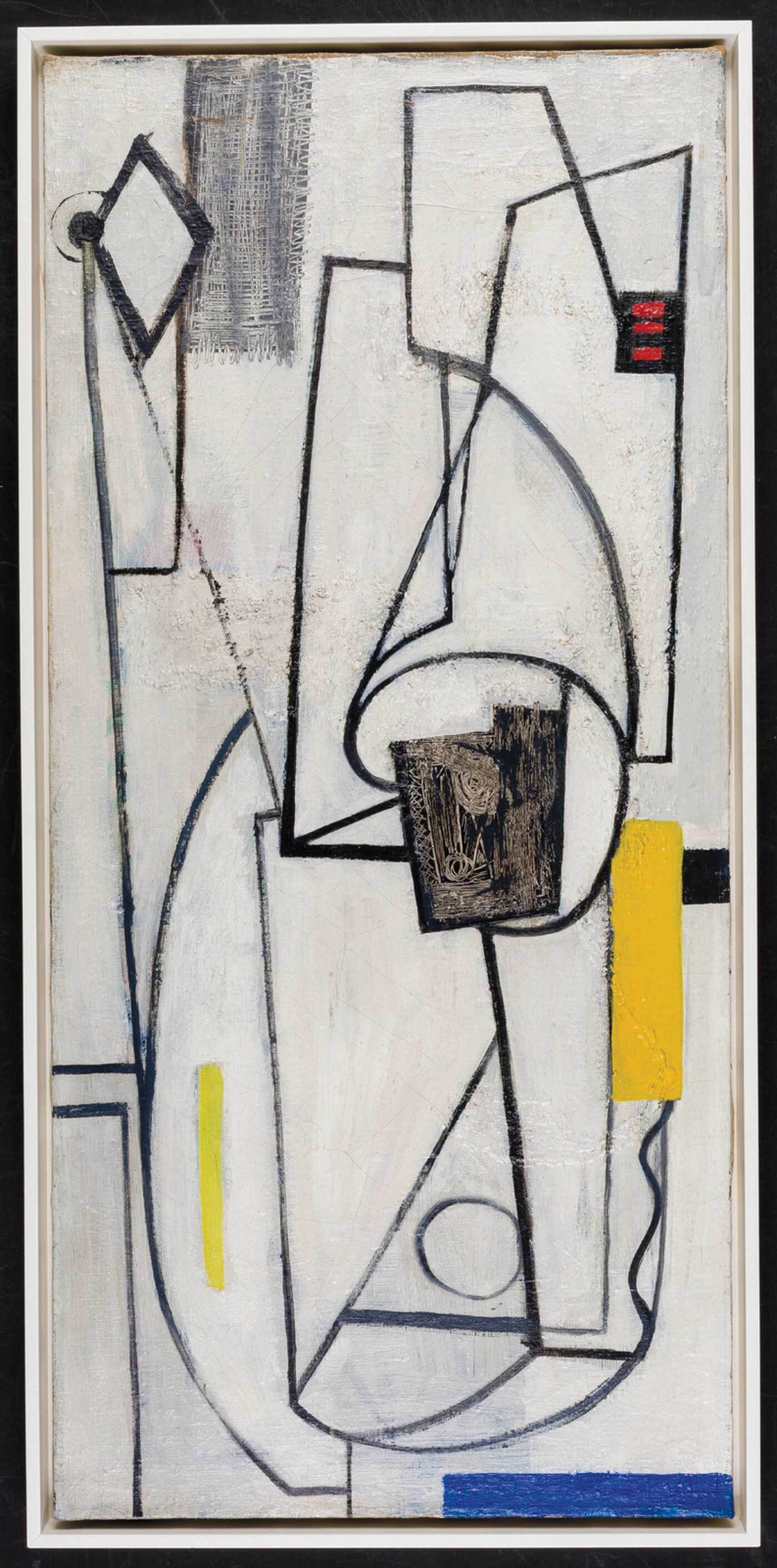
Oil with sand on canvas, 30 x 14 inches
Painted in 1947, Curious Personage exemplifies a mature abstract style Rothschild developed during her early, energizing New York years. The assertively vertical composition features a thick surface of white paint that varies between warmer and cooler tones. Small areas of primary color disrupt the white field—a horizontal band of deep blue defines the bottom right corner; a vertical field of bright yellow floats on the right side of the canvas and is echoed by a paler stroke of yellow in the lower left; and three red bars in a small black rectangle pull the viewer’s eye to the upper right of the painting. A black line drawing animates the entire composition, with both heavy contours and delicate marks defining irregular geometric shapes. At the center of the work, a passage of thin black paint bears a fine scribble of more geometric forms, perhaps scratched into the paint with the wooden end of her paintbrush. Rothschild’s varied mark-making and her use of gritty sand embedded in areas of the white paint demonstrate her experimental approach to abstract imagery. Overall, the composition loosely articulates the title’s “personage” with geometric shapes and lines that could be interpreted as facial features, while simultaneously situating the implied representational subject within a distinctly abstract vocabulary.
The same year Rothschild painted Curious Personage, she married and moved with her husband to California, where she would continue to paint in relative isolation. After her marriage ended, Rothschild returned to New York in the 1970s, where her artistic career thrived again, and she established a generous philanthropic platform to support other artists. The painting is currently on view in the newly reinstalled top-floor galleries in the Davis Museum, where it makes an important addition to the College’s holdings in mid-century American art.


Post a Comment
We ask that those who engage in Wellesley magazine's online community act with honesty, integrity, and respect. (Remember the honor code, alums?) We reserve the right to remove comments by impersonators or comments that are not civil and relevant to the subject at hand. By posting here, you are permitting Wellesley magazine to edit and republish your comment in all media. Please remember that all posts are public.