
On July 18, 2025, the U.S. Congress voted to pull back hundreds of millions of dollars already appropriated for public broadcasting. More than 50 years of continuous federal support for educational and information-based noncommercial broadcasting would abruptly end.
Soon after, Katie Colaneri ’10 says, her daughter, a preschooler and a fan of PBS Kids, turned to her and repeated something she had heard. “Mama, did you know that the Corporation for Public Broadcasting is a private corporation funded by the American people?” she remembers. Hearing this, Colaneri, an editor at New Hampshire Public Radio, teared up. “And I went, ‘Not anymore.’”
In January 2026, CPB voted to cease operations after disbursing the last of its funds and determining that to sit idle would leave too much to chance. In a widely quoted news release, the agency said a “dormant and defunded CPB could have become vulnerable to future political manipulation or misuse, threatening the independence of public media and the trust audiences place in it, and potentially subjecting staff and board members to legal exposure from bad-faith actors.”
The demise of congressional support and the dissolution of CPB don’t mean the end of public broadcasting, but the impacts will vary because federal funding went to such a broad array of recipients.
At this moment of change and uncertainty for public media, Wellesley alums in the industry—from pioneering correspondents to business leaders to current editors and reporters—discuss how the system is unique, what’s at stake, and why a future without federal funding is both possible and lamentable.
The public media ecosystem
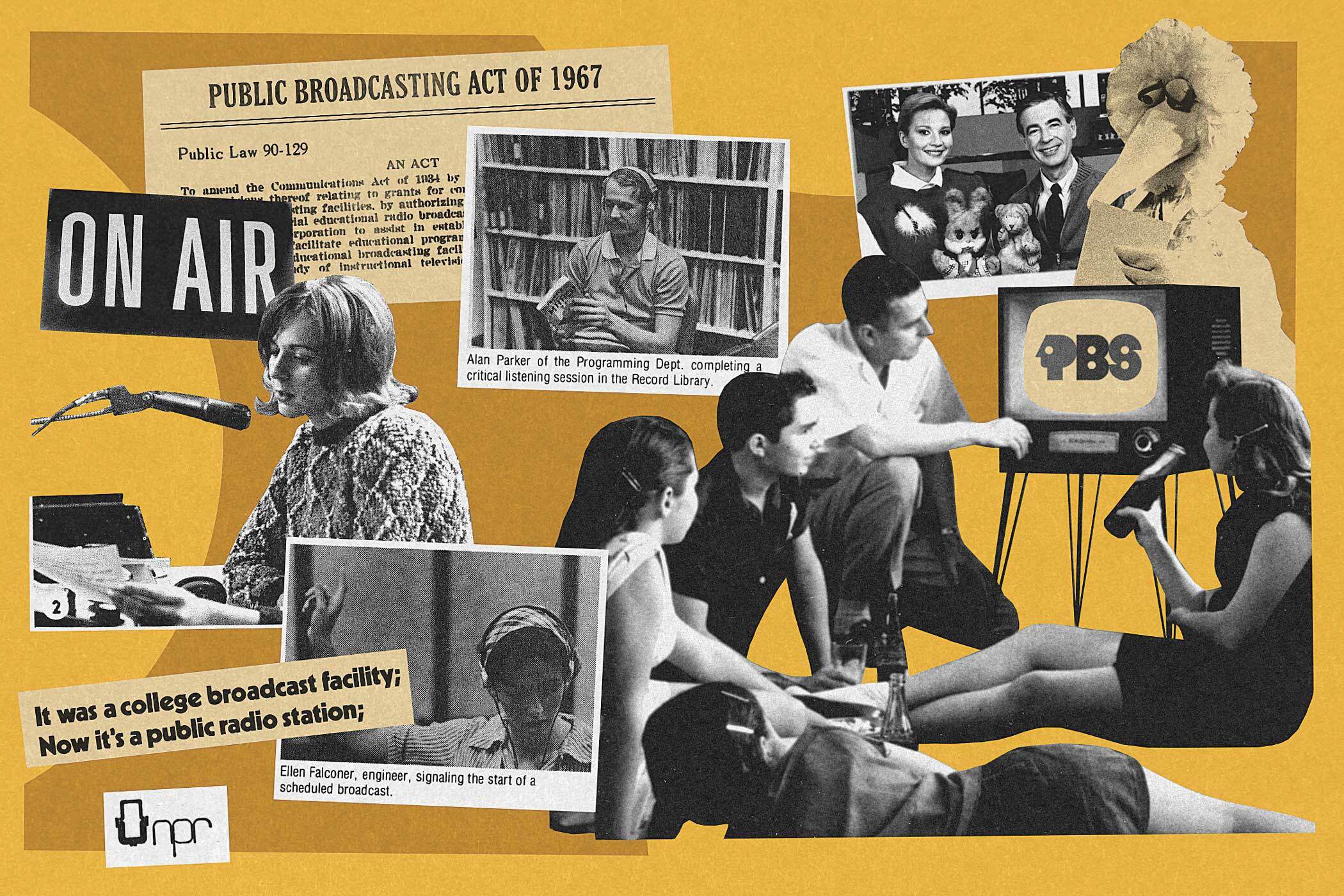
National funding for noncommercial radio and television was born with the Public Broadcasting Act of 1967. Public stations already existed to provide information and educational programming, and many were licensed to colleges, school districts, or other entities. Public stations are nonprofits, as opposed to commercial broadcasters, which are run by for-profit businesses. Today, some independent public media stations are incorporated as stand-alone nonprofits with their own Federal Communications Commission licenses.
The 1967 law created the Corporation for Public Broadcasting and gave it the role of dispersing federal funds, including about $500 million in the final iteration of Community Service Grants—that’s the money that vanished from local station budgets with the July rescission vote.
CPB also seeded national networks for public radio and television. These would distribute content to member stations.
Television’s Public Broadcasting Service (PBS) created a national distribution platform. It doesn’t produce programs, but it’s how Sesame Street and other children’s programming reaches millions of households across the socioeconomic spectrum every day, for free. PBS today has around 330 member stations, and the content it distributes ranges from wildly popular children’s shows to Ken Burns’ epic documentary projects to British dramas.
National Public Radio (later rebranded as NPR) is both a content producer and a distributor. It launched All Things Considered in 1971, originally airing on 88 member stations. Today, NPR has nearly 250 member stations.
In total, approximately 1,500 noncommercial TV and radio stations received at least some funding from CPB. Stations unaffiliated with NPR and PBS include many student stations, like Wellesley’s WZLY, and other community stations that create most of their own programming. They may also have access to shared programs through other networks or distributors, like Pacifica Network or the Public Radio Exchange.
Susan Harmon ’67 held leadership roles at public media stations in Washington, D.C., and Dallas. In 2001, she co-founded what is now called Public Media Company, where she serves as board chair. She is also a Wellesley College alumnae trustee. She says most people who listen to public radio or watch public television don’t understand how decentralized the system is, with every station having its own local identity. It is also not widely understood that NPR and PBS receive a substantial portion of their revenue from these stations that collectively pay for national programming.
Specifically, stations pay NPR and PBS for the programs they air. The stations would have to fill that airtime with other content if they didn’t subscribe to the networks. The networks did not have outlets for their efforts without stations, until the dawn of the digital age.
In Congress, opponents of public media often demonized NPR and PBS and seemed to think clawing back the appropriation to CPB would end the programming they didn’t like. But those two networks received proportionally less federal money directly from CPB than the individual stations did.
Of course, network member stations would receive CPB grants and pay PBS or NPR for programs. But by cutting all CPB funding, Congress eliminated local and independently produced content, too.
CPB also funded some capital and operating expenses for certain stations, particularly in remote areas where it’s most expensive to provide the service. And it had other grant programs for innovations in programming, interconnection systems, and distribution technology. CPB also often made starter grants to launch projects. I was a reporter for a collaboration called Harvest Public Media, covering agriculture, food, and the environment in the Midwest, which had CPB funding until the participating stations could fund it themselves.
“We don’t have a ton to fool around with, but we will spend what we have to cover news, whatever and wherever it is.”
—Karen Grigsby Bates ’73
Who makes what?
Avid listeners of NPR’s flagship shows will recognize the names of Linda Cozby Wertheimer ’65 and the late Cokie Boggs Roberts ’64, who were two of the network’s four “founding mothers.” Many alums have followed them.
Karen Grigsby Bates ’73 worked at NPR from 2002 to 2023 in various roles, but principally as a reporter covering race for the national desk and the Code Switch podcast team, which was launched with a CPB grant. She worked on it with producer Kumari Devarajan ’17. Bates says during her time, the attitude about funding was, “We don’t have a ton to fool around with, but we will spend what we have to cover news, whatever and wherever it is.” That helped NPR grow into a national news leader.
NPR does not rely exclusively on its own (however formidable) staff to build its shows. Member station reporters contribute stories, too. Often, they are the first people on the scene of a major developing story. But the network is also interested in “slice of life” stories from far-flung places.
Macy Lipkin ’23 is a reporter covering Spanish-speaking communities in northern Utah at Salt Lake City’s NPR member station, KUER. While her day-to-day work airs primarily on that station, you might have heard her delightful story about the group Lasagna Love, which made meals for furloughed federal employees and SNAP recipients who missed debit card refills during the long 2025 government shutdown.
“I emailed them,” she says, “and I was like, ‘What is the shutdown doing to your requests?’” The reply she got was that requests were through the roof, and someone was about to host a lasagna-making party. “And I was like, OK, I’m coming.” Lipkin headed over with her recording kit, and in addition to her local story, NPR broadcast a two-minute version during Morning Edition.
NPR pays local reporters a bit for contributions like that, but the reporters are employees of the station, not the network. Lipkin says until she started working in public radio, she didn’t really understand the difference between what came from a local station and what came from the national network. That’s common. Each station maintains its own staff and FCC licenses, and for the most part, each raises its own funding from the local community.
Lipkin says the distinction blurs when she’s talking with people who don’t recognize her station’s call letters but know it as the local NPR station.
And, she adds, “I do have one friend who introduces me to people as her NPR friend.”
I also have had friends refer to me as working at NPR, something I correct to various degrees depending on the context. The NPR staff deserve to be recognized for working at the national network, and local stations also want to be identified as independent. But stations undeniably benefit from their affiliation with NPR. Over the past several years, many television stations have rebranded to include PBS in their names, such as Rocky Mountain PBS and Kansas City PBS. Some stations have both TV and radio operations, while others have only one.
Before the internet, NPR and PBS had no way to get their programming to listeners and viewers other than through local stations.
Podcasting, YouTube, and custom apps now allow the networks, and individual stations, to make content available directly to consumers.
At New Hampshire Public Radio, Colaneri is the senior editor on the Document team, which produces long-form narrative podcasts. It’s a kind of storytelling she discovered during her time in Wellesley-in-Aix.
Lonely and homesick, she downloaded an episode of This American Life. “I just remember getting to the end of it and just being so blown away and thinking to myself, ‘Oh my god, this. What is this? How do I do this for a living? This is what I want to do,’” she says.
It took her a decade of working her way up in local journalism, first at a newspaper then at a couple of NPR member stations (and plenty of networking with other Wellesley alums), before she landed the job in 2022.
Local public service
The heart of public media is local responsibility, which means accountability to the community. Most stations offer some amount of local programming: often newscasts and feature reporting, talk shows, music shows hosted by staff or volunteers, or lecture series from a community partner or the station’s license holder. In big cities, the local public media reporters may compete with newspapers or commercial TV stations. In small towns, the public radio station might be the only local news outlet.
Things have changed a lot since NPR and PBS were created, but some fundamentals remain true. Today, you can stream almost any public radio station from any internet connection. But back in the 20th century, you’d have tuned the dial of an AM or FM radio receiver to a specific number, likely in the upper 80s or lower 90s, for the signal of your local station. During a given day, you’d likely get some national programming, some local weather, traffic and news, maybe a local talk show, possibly some music. Most of that content would not have been available to you on any other frequency.
Occasionally, the jarring blare of the Emergency Alert System would likely be followed by an announcement that “this is only a test.”
But what about when it’s not a test? The public airwaves are a primary vehicle for announcing dangers and blasting information to wide geographic areas. Today, mass alerts go out over cell phones, but in many cases, people have to opt in. While there’s no guarantee someone would be listening to the radio, everyone who was tuned in when an emergency alert aired would hear it simultaneously.
During the rescission debate, Sen. Lisa Murkowski, a Republican from Alaska, told her colleagues that the cuts threaten disaster alerts. The next day, alerts went out after a powerful earthquake struck the state. The widespread flooding and power outages in western North Carolina following Hurricane Helene are an example of when the local public radio station played a critical role in getting urgent information to large populations across vast areas. After initial alerts, local stations can be live on the air with updates as often as necessary. Even in the internet age, most cars still have FM radios, and when there’s no electricity, those can be a lifeline. Commercial radio networks may have stations in many places but often do not staff them.
When local stations received CPB grants, their amounts varied widely. At the station where I work, KAZU in Monterey, Calif., our CPB grant was about 10% of the budget. Seeing that zeroed out hurt, but did not jeopardize our regular operations. We did not have any layoffs. Some stations received 30% or more of their budgets from CPB. Even some of the largest stations, including GBH (the Boston station, which has dropped its W) and KQED in San Francisco, had layoffs after the rescission, often on the video side, which is more expensive than audio.
Harmon says the rescission of federal funding came swiftly, and stations in small towns and rural areas that had previously received 25% or more of their annual budgets from federal funding were hurt the most. The Public Media Company, with the support of major foundations and individuals, quickly organized the Public Media Bridge Fund to provide emergency grants and consulting services to these vulnerable stations.
“We’re getting money from places and people we don’t even know,” Harmon says. “The generosity and vision are amazing.” She believes it is because “there is a belief in the value of noncommercial media grounded in a mission to provide community service, free access, and a commitment to truth-telling and cultural enrichment.” When we spoke in February, Harmon said PMC had raised nearly $70 million for the bridge fund.
What it takes
Callie Crossley ’73 is a host and a commentator at GBH and a Wellesley trustee. She knows better than many that making television is expensive and that public broadcasters have always done it for far less than their commercial counterparts.
Crossley worked at local TV stations in Memphis and Indianapolis at the start of her career before taking a job at (then) WGBH. She went from producing daily-turn stories that were 90 seconds long to working on six- to seven-minute local news pieces, also on tight deadlines. Then she jumped to the ABC News program 20/20, where she worked on projects that ran 14 minutes and took weeks or longer to produce.
“When I arrived at ABC News 20/20, the producing staff was up in arms,” she says. “The ruling had just come down that producers could no longer—wait for it—rent private planes to transport interviewees.”
So, the financial resources at ABC? “I would say, mind-blowing,” she says.
Even in the era of federal funding, public stations had to work hard to raise all the money they needed to do the work they set out for themselves.
When people ask her how things are going now, Crossley says, she points out the context.
“You have to remember, we had to do a robust fundraising campaign when we had federal money,” she tells them. “Now we are trying to raise all the money. And it can’t be a one-time thing. [There] has to be a lot of sustainability from [this] time on now.”
Right after the summer 2025 rescission announcement and in fundraising campaigns throughout last fall, stations around the country reported historically high donations. But those are not likely to continue indefinitely.
Colaneri says that at New Hampshire Public Radio, despite a surge of support, the leadership has been clear that “we know rage-giving isn’t sustainable.”
Harmon believes public media is sustainable, although it may take some new forms. “At PMC, we’re thinking about, what does the future look like and, structurally, how do we organize it?” she says. “It may not be that every station is separate. There may be more mergers, more partnerships. We must build a case and models for the future of public media and its importance to democracy and informed communities in this country.”
So stay tuned. And remember, as avid listeners can attest, presentation of the programming you enjoy is made possible by you.
Amy Mayer ’94 is the news director at 90.3 KAZU (kazu.org) and in addition to California has worked at public radio stations in Iowa, Massachusetts, and Alaska.


Post a Comment
We ask that those who engage in Wellesley magazine's online community act with honesty, integrity, and respect. (Remember the honor code, alums?) We reserve the right to remove comments by impersonators or comments that are not civil and relevant to the subject at hand. By posting here, you are permitting Wellesley magazine to edit and republish your comment in all media. Please remember that all posts are public.