
Anthropology professor Adam Van Arsdale starts ANTH 240: Monkeys, Apes, and Humans by showing what Google produces when you image-search the phrase “What is a primatologist?” The first result? A cartoonish illustration of a white woman—high ponytail, short khaki shorts—crouching to take notes on a monkey eating a banana. The second result? A photo of a young Jane Goodall grooming a chimp.
Unlike many sciences, primatology has been dominated by women for decades. Studying nonhuman primates gained high visibility in the 1960s because of the “Trimates”—three young women paleoanthropologist Louis Leakey chose to study animals in the wild. Jane Goodall’s observations of chimpanzees, Dian Fossey’s research on gorillas, and Biruté Galdikas’s work with orangutans became a global sensation. Young girls learned about “Leakey’s Angels” and pictured themselves in the field, observing monkeys and apes.
“There’s also this idea that studying social relationships is coded as female,” says Van Arsdale. For a long time, men dominated paleontology and archaeology, while women ended up in primatology because, as Van Arsdale explains, “somehow caring for animals is a female-marked discipline.” But don’t forget: Humans are primates. “We often take our behavior for granted,” Van Arsdale says, “but our personalities shape our behavior, which shapes our relationships”—which are the backbone of society.
Regardless of how they find their way into the field, women have made major advances as primatologists for the past 60-plus years—and among them are many Wellesley alumnae.
What even is a primatologist?
One of Wellesley’s early primatologists, Laura Jane Beckman Lancaster ’58, born one year after Goodall, in 1935, was also called Jane. In 1967, Lancaster earned a Ph.D. in anthropology from the University of California, Berkeley, where she researched primate communication. Lancaster ultimately settled at the University of New Mexico in 1985, and she became “without a doubt one of the most prominent anthropologists and human evolutionary scientists,” according to a UNM colleague’s tribute in Human Nature: An Interdisciplinary Biosocial Perspective, a journal she founded. She was trained in both biological and cultural anthropology, and her pioneering research covered a broad range of topics, from play among primates, to human teen pregnancy and single parenthood, to the evolutionary benefits of grandmothers. In her groundbreaking 1991 article “A Feminist and Evolutionary Biologist Looks at Women” she argued that women are not passive reproductive partners, but strategic decision-makers solving a specific problem: whether and how to raise slow-growing, high-cost children in an unpredictable world. Lancaster, who passed away in August 2025, two months before Goodall, was a mentor for many women in anthropology, including the acclaimed Barbara J. King, well known for her work on animal cognition and emotion.
But you don’t need a Ph.D. in anthropology to be a primatologist. “A primatologist is someone who works with, cares for, researches, and/or advocates on behalf of nonhuman primates in a variety of captive, sanctuary, and ‘wild’ settings,” Van Arsdale tells his students—meaning a primatologist can be the Ph.D. student taking notes on the gorillas, but also the local guide who tracks and follows the great ape populations, or the park ranger armed with a gun to protect the animals from poachers, or the intern who feeds nonhuman primates in a sanctuary or zoo. Many subjects can become a pathway to primatology—anthropology, biology, zoology, conservation, psychology, education, and even the humanities. “There are many, many ways to be a primatologist,” says Van Arsdale.
Unlikely paths to primates
At Wellesley, neither Sarah Blaffer Hrdy ’68 nor Dorothy Cheney ’72 studied biology. Hrdy focused on English and philosophy, while Cheney was a political science major, but both became acclaimed primatologists and colleagues of Lancaster—in a way, the three formed a Wellesley alumnae version of the Trimates.
Like many political science majors, Cheney, who died in 2018, assumed she would go to law school. But in 1971, during her senior year, she married Robert Seyfarth, a Harvard biological anthropology student who had applied to spend a year in South Africa studying baboons with zoologist Robert Hinde. She put off law school to join him, and her life changed course. Soon Cheney herself applied to study under Hinde, and when he showed Cheney’s transcript to his wife, a Mount Holyoke alumna, she commented, “Anyone who gets these grades at Wellesley is going to be smart.” Cheney earned a Ph.D. in zoology from Cambridge in 1977.
Cheney and Seyfarth were research partners as well as spouses, and Seyfarth says they often described what they studied as the “political science of life among baboons.” Cheney was a strong writer and emphasized the value of her “first-rate political science education” and intellectual training at Wellesley. They formed a powerhouse team, teaching together at the University of Pennsylvania for over 30 years and spending long stretches of time in Africa studying gorillas, baboons, and vervet monkeys.
“Monkey society is governed by the same two general rules that governed the behavior of women in so many 19th-century novels,” Cheney and Seyfarth wrote in Baboon Metaphysics: The Evolution of a Social Mind (2007). “Stay loyal to your relatives (though perhaps at a distance, if they are an impediment), but also try to ingratiate yourself with the members of high-ranking families.”
A few years before Cheney arrived on campus, Hrdy was an aspiring writer at Wellesley, working on a novel about a family of Mayan descent. She loved creative writing and mythology, and she found herself studying anthropology-adjacent topics as she did background research for her novel. Hrdy became so engrossed that she transferred to Radcliffe to study under “the great Mayanist” Evon Z. Vogt. “Everything I’ve done was driven by curiosity,” says Hrdy.
While working on summer medical projects in Central America, she became interested in public health and decided to enter a Stanford program to learn to make educational films for people in developing countries. At Stanford, a lecture on overpopulation sparked her interest in a species of male langurs in India that—supposedly because of overcrowding—killed langur babies. Hrdy decided to return to Harvard to study primatology, doing research for her Ph.D. in India to discover why the male langurs behaved this way. Hrdy concluded that infanticide was actually a male reproductive strategy.
“I’m deeply interested in what makes us human, and part of what makes you human is being similar to the rest of the natural world.”
—Sana Saiyed ’12
“These days, instances of males behaving badly are all over the news,” says Hrdy with a chuckle. “Limiting options that females have is something many male primates do.” In The Langurs of Abu: Female and Male Strategies of Reproduction (1977), Hrdy strove to correct what she saw as androcentric bias in primatology by devoting equal space to both sexes. Disappointed when the reviews focused mainly on the male strategies, she wrote The Woman That Never Evolved (1981), which focused on how females will compete among themselves for rank and resources, but will bond together for mutual defense. The book became something of a feminist manifesto, but “rather than being feminist,” Hrdy says, “I simply wanted to be a better scientist.” Hrdy went on to study topics including infanticide, maternal love and ambivalence, care by individuals other than the biological mother, and, in her most recent book, Father Time (2024), the nurturing potential of males.
“Thinking back to the years at Wellesley, I doubt Dorothy, Jane, or I imagined that our paths would include studying wild monkeys,” says Hrdy. “It was only later that our lives intersected, and it was primatology that brought us together.”
Lancaster, whom Hrdy describes as a role model and mentor, edited one of Hrdy’s papers. Hrdy was honored to present Lancaster a Lifetime Career Award from the Human Behavior and Evolution Society in 2012, and in 2021, Lancaster was elected to the American Academy of Arts and Sciences, joining Hrdy and Cheney.
Cheney, Hrdy, and primatologist Joan Silk organized the Symposium on Primate Reproductive Strategies in 1986. “At the time, few members of the American Anthropological Association viewed field primatology as relevant to their interests,” says Hrdy. “Dorothy and I wanted to help change that by organizing a symposium showcasing just how interesting and potentially relevant to anthropological concerns primate behavior could be.” Though all three women had new babies at the time, they created a successful event. Hrdy was still breastfeeding: “I was suffering from postpartum amnesia and don’t remember that much, but somehow, it all worked out well.” She was elected to the National Academy of Sciences in 1990 and says it was her “great pleasure” to welcome Cheney into the Academy in 2015.
Hrdy says she, Lancaster, and Cheney were “three women who loved books, wanted to better understand who we were and the world we lived in, put a high value on integrity, and respected scholarship. No wonder we became good friends.”
21st-century trimates
Though their paths to becoming a primatologist varied, recent Wellesley alums in the field have something in common: Adam Van Arsdale.
Sana Saiyed ’12, Kylie Sorenson Kean ’17, and Eliana Sonderling ’22 each took ANTH 102: Introduction to Biological Anthropology with Van Arsdale, who is trained as a biological anthropologist specializing in paleoanthropology. Kean and Sonderling did independent studies with him, focusing on nonhuman primates, and those studies became the basis for Van Arsdale’s course ANTH 240: Monkeys, Apes, and Humans, first offered in spring 2024.
Saiyed, an assistant professor of anthropology at Rollins College of Liberal Arts in Florida, says she stuck with anthropology because of Van Arsdale’s support and encouragement. “When I was a kid, I wanted to be a big cat specialist,” says Saiyed, who was an anthropology and history double major. “I didn’t expect to be a primatologist or anthropologist until I came to Wellesley.” But she says Van Arsdale was “very open about what is possible” in the field of anthropology. After Wellesley, teaching high school biology through Teach for America inspired her to pursue a master’s in social sciences, with a focus on evolutionary biology, at the University of Chicago. Saiyed worked at the Lincoln Park Zoo, studying Japanese macaques—observing how the monkeys responded to visitors to the zoo and how visitors interpreted the monkeys’ behavior.
As Saiyed pursued her Ph.D. in anthropology at the University of Notre Dame, she began studying monkeys in her mom’s hometown in India. “Monkeys are culturally significant in India,” says Saiyed. “They are associated with a god in Hinduism—it’s an act of worship to feed the monkeys and illegal to harm them—but that perception is changing.” Saiyed studies the cultural, political, and ecological factors that influence people’s perceptions of the primates they live with, and how that impacts primate social behavior. The COVID-19 pandemic prevented Saiyed from finishing her research in India, but she pivoted and studied human-monkey relationships on St. Kitts. Monkeys were brought to the island 400 years ago by French traders, and they are a source of pride for the nation, explains Saiyed. The monkeys are pictured on St. Kitts’ stamps and souvenirs, “but at the same time, you have farmers and regular folks who are getting really mad about the monkeys destroying crops. I studied how perceptions [of the monkeys] vary demographically—for example, how the wealthy white immigrants in a neighborhood think about the monkeys versus the lower income Afro-Caribbean workers in the same neighborhood.”
The core of Saiyed’s research is monkeys and people watching each other: “The reason I love primates so much is that they are so deeply similar to us,” she says. “I’m deeply interested in what makes us human, and part of what makes you human is being similar to the rest of the natural world.”
Unlike Saiyed, Kean knew she wanted to study nonhuman primates before even arriving at Wellesley: “I decided I wanted to be Jane Goodall when I was 10 and never really gave that up,” she says. She spent summers interning at Chimp Haven, a sanctuary in Louisiana, and the Duke Lemur Center in North Carolina, and, thanks to funding from Wellesley’s Center for Work and Service, now the Lulu Chow Wang ’66 Center for Career Education, researching tamarins in the Amazon. After Wellesley, Kean moved to the U.K. to pursue a master’s in primate conservation at Oxford Brookes University.
Concurrently, Kean was studying early childhood education. She worked at the Wellesley Community Children’s Center as a student, and after graduating, she helped the WCCC start its preschool nature classroom. She also led expeditions in Madagascar for middle school children to see lemurs. One of those middle schoolers is now studying biodiversity and climate at university, influenced by that Madagascar trip.
“The connection that you form [with nature] at an early age is so influential for the rest of your life in terms of your environmental stewardship,” Kean says. She now works for the education nonprofit Change is Simple, whose goal is to instill “lifelong social and environmental responsibility through experiential learning that inspires action.” Kean’s students love to ask her about working with monkeys and apes—and she’s happy to oblige with stories, such as the time Kean, who also is a dancer, performed a tap routine for 200 chimpanzees as an enrichment activity. Once Kean noticed two of her students observing their classmates, taking meticulous notes. When Kean asked what they were doing, they told her they were “playing primatologist.”
Sonderling, meanwhile, has been “playing primatologist” for real since graduating from Wellesley; when interviewed for this article, she was living in Loango National Park in Gabon studying a habituated population of western lowland gorillas. But living among nonhuman primates is nothing new for her. When Van Arsdale and Sonderling first met, she was Zooming into his biological anthropology class from a primate sanctuary. It was fall 2020, and while many Wellesley students were isolating at home with pesky younger siblings or the family dog, the neuroscience major was holed up with 40-plus monkeys and chimpanzees at the Primate Rescue Center in Nicholasville, Ky.
“I ended up living in a room right next to where the chimpanzees live,” says Sonderling. “They had a playroom and a bedroom, right next to [my] apartment.”
Sonderling has also worked with baboons in South Africa, Barbary macaques in Morocco, bonobos in the Democratic Republic of Congo, and chimpanzees in Cameroon. Interested in primates that live within human environments or in environments impacted by humans, Sonderling wants to study human-primate conflict, and “reframe that issue as one of potential coexistence, rather than one of inevitable conflict.” She will be pursuing this research for a Ph.D. in anthropology at the University of Michigan, Van Arsdale’s alma mater. But she plans to stay in Loango until she heads to Ann Arbor.
“We have no interaction whatsoever with any of the wild primates that we’re studying,” says Sonderling of the gorillas in Loango. She loves “just to be able to watch them and to see them living their lives and having relationships with each other like they should be able to.” Sonderling and her fellow primatologists trade stories about the gorillas’ activities the way other people talk about drama on Love Is Blind. “They are wild, but they allow us into their space and allow us to watch them,” says Sonderling with awe.
And not just watch them: Sonderling takes photos and videos, which she sends to Van Arsdale, who shares them with his ANTH 240 class.
“Don’t worry,” Van Arsdale tells his students, as he cues up a video Sonderling took of a mother gorilla climbing down a tree with her baby clinging to her back. “We won’t go a week without watching primates.”
E.B. Bartels ’10 is Wellesley’s senior editorial writer and the author of Good Grief: On Loving Pets, Here and Hereafter, which features a famous nonhuman primate in chapter seven.
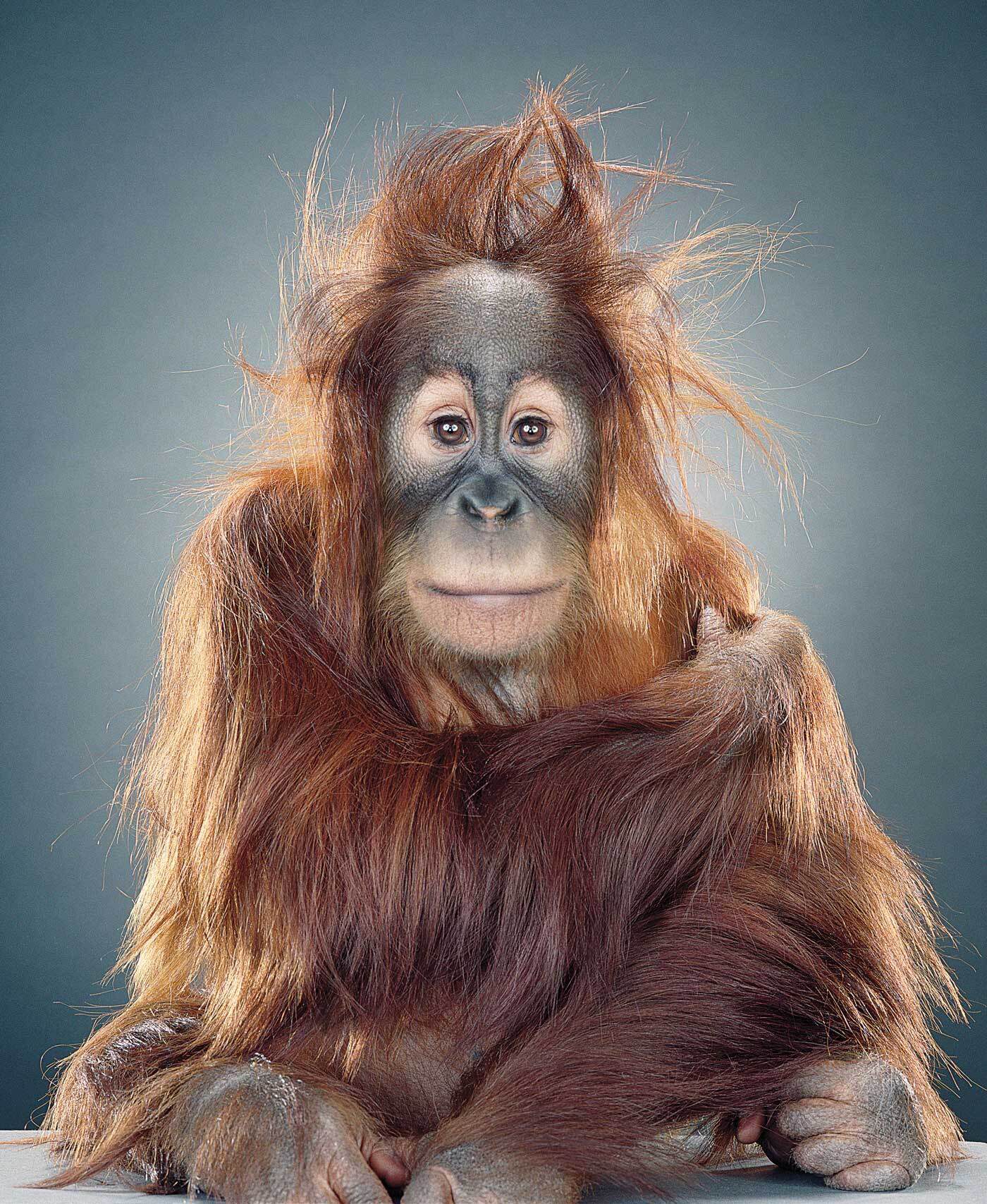
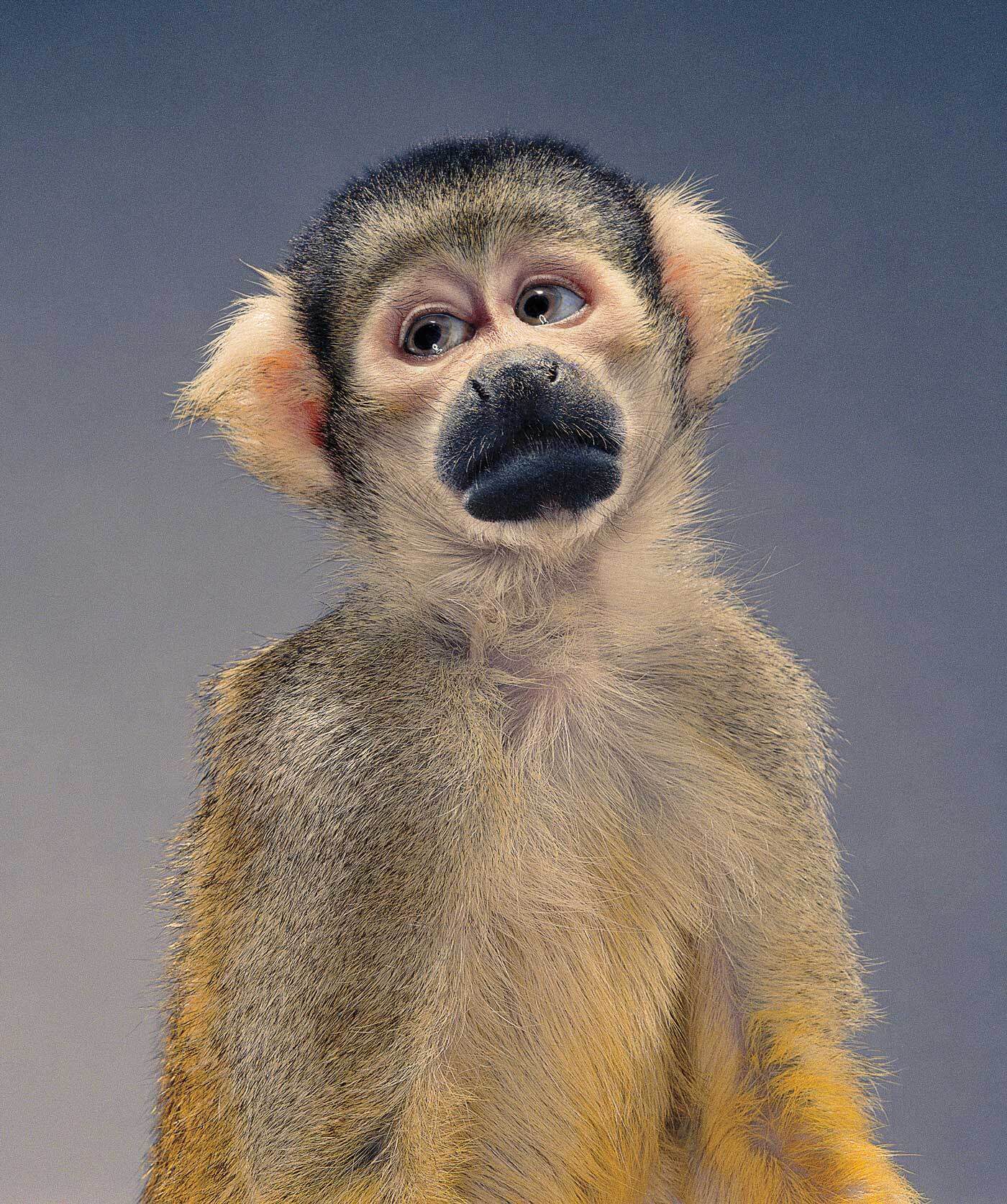
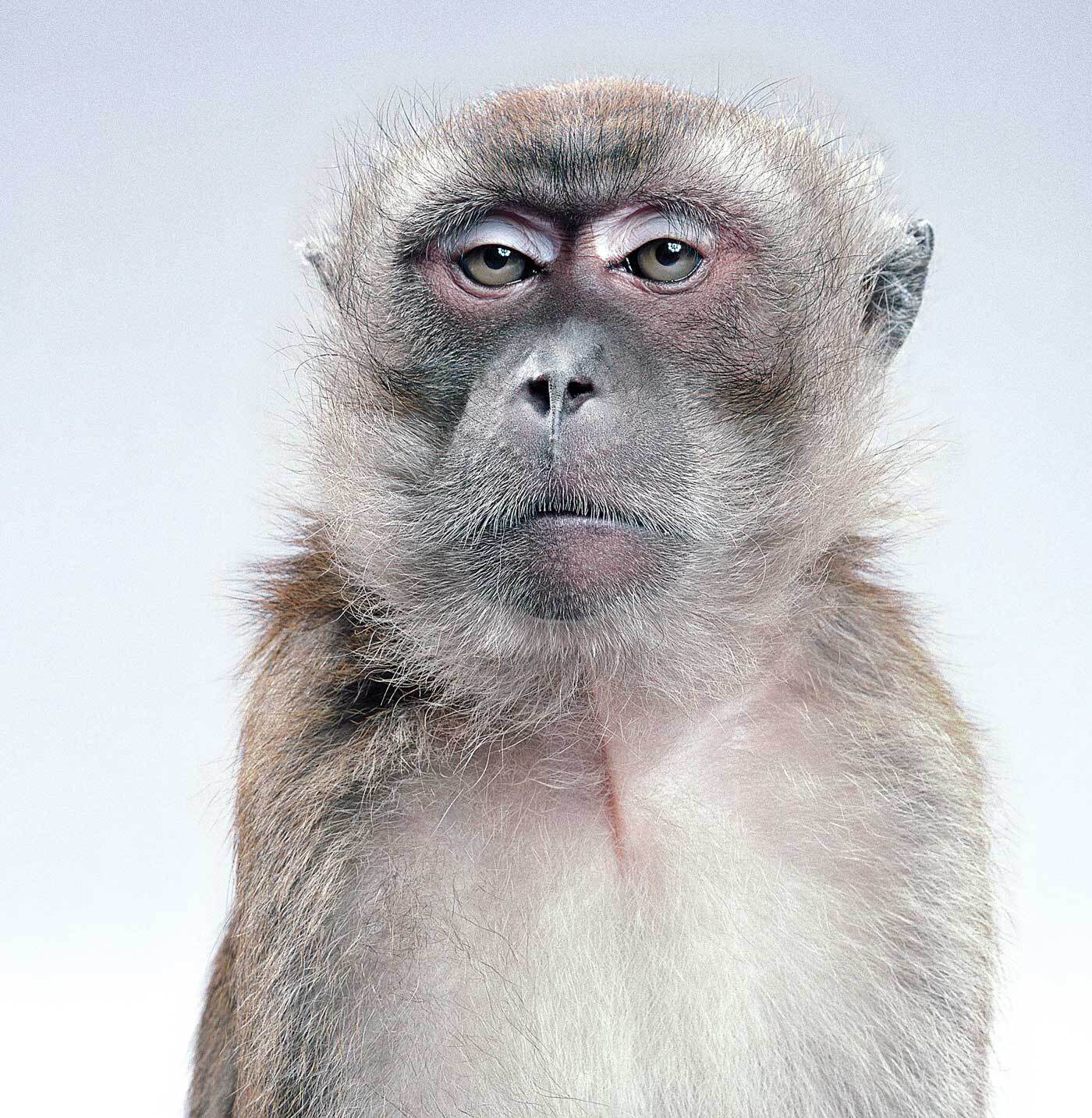
Photos copyright Jill Greenberg, courtesy Clamp Gallery, New York. These “Monkey Portraits*” are part of a fine art series of monkeys and apes made in 2001–2005.


Post a Comment
We ask that those who engage in Wellesley magazine's online community act with honesty, integrity, and respect. (Remember the honor code, alums?) We reserve the right to remove comments by impersonators or comments that are not civil and relevant to the subject at hand. By posting here, you are permitting Wellesley magazine to edit and republish your comment in all media. Please remember that all posts are public.
I just returned from attending my granddaughter, Julia Hanson's graduation from Wellesley... her major, Anthropology! I will alert her to this article. I have always been an animal person and hoped to learn horse and dog language better and show others some signs of understanding of each other who live on the same planet. Vivien ( Class of 1954 )