
Does quantum physics play a role in consciousness? For decades, the idea was dismissed as a fringe possibility. However, recent papers by Mike Wiest, associate professor of neuroscience at Wellesley, and his students in eNeuro and Neuroscience of Consciousness are part of a new wave of findings giving credence to the idea.
Wiest first became captivated by the conjecture as a physics graduate student in the 1990s, when Nobel Prize-winning physicist Roger Penrose and anesthesiologist Stuart Hameroff proposed that quantum processes in microtubules—narrow, tube-like structures found within cells’ cytoplasm—might help explain how consciousness arises.
“Since the beginning of life, before neurons, microtubules have been participating in collecting environmental information, including, apparently, electromagnetic information, and moving in response, which is what our brain is for, ultimately,” says Wiest, and he adds that it’s not a stretch to imagine they have something to do with consciousness. The main objection to the quantum idea has been that quantum effects usually require super-cold temperatures. “And our brain is not super cold, so everyone thought it was ridiculous,” says Wiest.
“I’m excited that I’ve been able to become part of that conversation [about quantum physics and consciousness]—because of my experimental results with my students.”
But Wiest was convinced that classical physics cannot solve the “binding problem”—how signals in different parts of the brain are combined to form a unified perception (see “In a Bind,” below)—and that scientists needed a quantum approach.
For years, however, Wiest used tools of classical neuroscience to study the binding problem. He implanted microelectrodes in rats’ brains and recorded their brain activity after training them to do sensory-guided tasks. But recently, he hit on a surprisingly low-tech way to explore the microtubule idea more directly. His team used an anesthetic gas, isoflurane, to render rats unconscious. But first, they gave the rats a microtubule-binding drug.
“There’s a large class of drugs used as anti-cancer agents that bind to microtubules,” he says. “The thing is, until recently, most of those drugs didn’t penetrate well into the brain. … But recently, people have developed versions of those drugs that do penetrate well into the brain, and they’re hoping to use them against brain cancers. So somehow I came across that fact, and it occurred to me that that would be a way to do the experiment.”
The result? Rats given the microtubule-binding drug took longer to fall asleep under anesthesia. The implication: The drug interfered with the anesthetic’s ability to bind to microtubules. It’s intriguing evidence that microtubules may indeed play a role in consciousness.

Now, Wiest and his students are trying similar experiments in mice—and even in single-cell organisms. These creatures have no neurons, yet they respond to anesthetics much like humans do. “They do have microtubules,” Wiest points out. “So we don’t know if it’s making them unconscious, but it makes them stop wiggling around, reversibly.”
Yixiang Huang ’25, a co-author on Wiest’s eNeuro paper who worked replicating the results in mice, says, “One thing I love about research is there are always new questions coming up. … It’s challenging and frustrating sometimes as well, but I enjoy the process.”
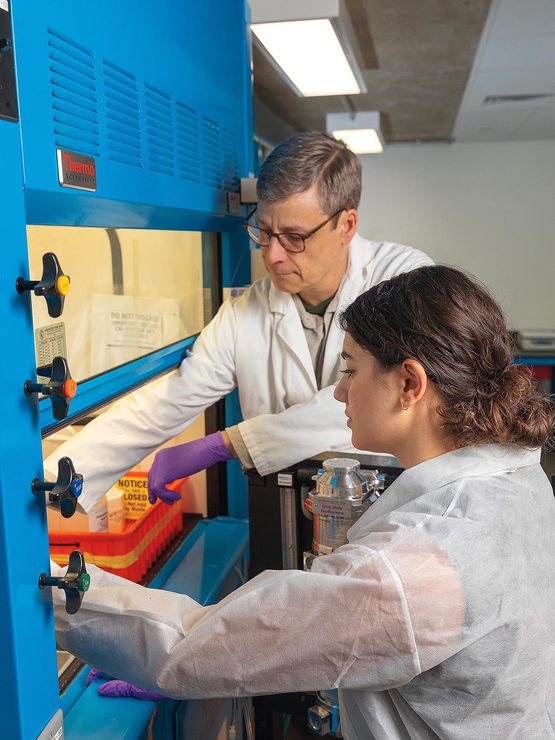
For Derin Timuçin ’27, the most exciting part of working on the project is being exposed to multiple parts of neuroscience. “It wasn’t solely about working with drugs and animals, but also the computational aspect of how you analyze the data, and how you gather the information to actually publish a paper,” Timuçin says. “I don’t think I would be able to … publish a paper on a topic like this if I hadn’t come to Wellesley.”
This latest work marks a turning point in Wiest’s career. “I was worried I was going to have to check out before ever getting to be part of the conversation about the quantum idea,” he says. “But I’m excited that I’ve been able to become part of that conversation—because of my experimental results with my students.”
In a Bind
This is the Binding Problem: How can neural activities all over the brain be experienced together, as a single unified perception? In other words, how are different features—like colors, shapes, sounds—bound together into a single moment of experience? This problem can’t be solved by a classical model, in which every larger-scale whole can be reduced to parts acting on their neighbors. For example, a tornado can be described using a classical model by breaking it down to the interactions of molecules of air. But consciousness is different; it’s a whole that can’t be broken into pieces without losing what it is. Similarly, the state of a quantum system is an irreducible whole, which enables classically impossible feats of memory and computation. Thus a quantum model solves the Binding Problem and explains how conscious brain processes could be advantageous evolutionarily.
Mike Wiest


Post a Comment
We ask that those who engage in Wellesley magazine's online community act with honesty, integrity, and respect. (Remember the honor code, alums?) We reserve the right to remove comments by impersonators or comments that are not civil and relevant to the subject at hand. By posting here, you are permitting Wellesley magazine to edit and republish your comment in all media. Please remember that all posts are public.