
When a college has been around for 150 years, some lore is bound to have accumulated. Wellesley’s oral history is rife with legends—some true, some false, and some somewhere in between—and as the College enters its sesquicentennial year, the magazine editors tasked E.B. Bartels ’10 with getting to the bottom of some of the most famous ones.
1) Claim: Galen Stone Tower was struck by lightning the one and only time a man was president of Wellesley College.
Rating: True
Since its founding in 1875, Wellesley College has had 14 presidents—all women. However, sometimes the tenure of one president ends a little before the next arrives, and then a senior-level member of the administration has to step in.
In 1972, between the reigns of presidents Ruth M. Adams and Barbara W. Newell, Executive Vice President Philip Phibbs, previously a professor of political science, bridged the transition as interim president during summer 1972, the first man in that role. On July 19, 1972, around 6 p.m., during a “severe electrical storm” (according to the College Archives), Galen Stone Tower was struck by lightning.
In 2007, a second man served as interim president, between Diana Chapman Walsh ’66 and H. Kim Bottomly—professor of history and then-provost Andy Shennan. “Campus police called to tease me about what happened the last time a man held the title,” Shennan says, with a laugh. No buildings were struck on his watch. However, Galen Stone Tower was hit by lightning in 2021 during the COVID-19 pandemic, so maybe it’s just an every-50ish-years kind of thing.

2) Claim: There is an endowment at Wellesley to ensure that every dining hall on campus always has ice cream.
Rating: False
Who from my era at Wellesley can forget “Sundae Sunday” in Tower? Lingering at a wooden table for hours while enjoying big bowls of ice cream with friends and putting off the reality of the upcoming week is one of my favorite college mealtime memories. I know many alums feel the same way, which explains the long-standing rumor that Wellesley’s development office endowed funds specifically to ensure that there would never be a shortage of ice cream.
This, alas, is not true. Development’s director of donor relations (a.k.a. “The Queen of Endowments”) Kirsten Burch confirms that there is no ice cream endowment. But did you know that there is a special gift specifically for s’mores?
When Vice President for Development Marisa Jaffe ’95 began her career at Wellesley in 2006, the Lulu Chow Wang [’66] Campus Center had just been completed. “Lulu really wanted to do something for the students,” says Jaffe. “She cared about making the campus center a place for everyone to gather, and while she didn’t dictate a lot of things about her gift, like what the building should look like, the one thing she asked for was a firepit.”
Mei-Mei Tuan ’88, one of Wang’s nieces, decided she also wanted to do something that would be fun and draw the students to the new campus center. Mei-Mei conferred with Lulu, who immediately applauded her idea: s’mores!
“It’s a wonderful way to gather people together, around the warmth of a fire,” Wang says. “Every year Mei-Mei supports getting the supplies and the delicious chocolate, marshmallows, and graham crackers to make s’mores, and it has become a Wellesley tradition to have this special treat while celebrating sisterhood.”
3) Claim: Professor of History and Provost Emeritus Andy Shennan’s British accent is fake.
Rating: False
Last summer, Shennan was at a family wedding in Scotland when one of his British nieces told him she had met a Wellesley alum at a social event who assured her that her uncle’s accent was fake.
“I would be the first to confess I am a bit mid-Atlantic now,” says Shennan, who left the old England for New England in 1988. “As soon as I heard the story, I thought it made perfect sense.” Shennan, who grew up in northern England, says he never had a strong regional accent, and now Americans think he sounds very British, while British people think he sounds more American. “People tell me that you get a lot of undeserved credit for having a British accent in America,” says Shennan. Did he read the names of graduating seniors at commencement for so many years because he was the provost, or simply because he had the voice of a Masterpiece Theatre host? We’ll never know.
But where did this legend come from? “I don’t remember where I first heard this rumor, but when I joked about it to a Wellesley friend last summer, I was delighted to find out that he was actually the one who started it—or at least was the most recent propagator,” says Grace Ramsdell ’22, former Wellesley magazine class notes editor. “He, in turn, was delighted to witness the fruits of his mischievous labor.”
4) Claim: Hills around campus were created to encourage students to get exercise.
Rating: Technically false, true in spirit
“To my knowledge, the hills are natural topography,” says Michelle Maheu, former assistant vice president of facilities management and planning, “and buildings were sited on top of hills intentionally to take advantage of the breeze (think: fresh air for health) and beautiful views (think: mental health). This was a foundational approach to our campus development, led by our founder, Henry Durant, to align with his vision of complete wellness (physical, mental, and spiritual).”
In a 1902 letter to President Caroline Hazard about siting buildings at the College, landscape architect Frederick Law Olmsted, Jr., recommended placing them on the escarpment to follow “its curve with their length by various angles and breaks … forging an almost continuous line with [it]” and leaving the meadows untouched.
So, while the hills were not artificially made, I will argue one definitely stays in shape walking around campus. That hill between Tower and Lulu is a beast.

5) Claim: The Lulu Chow Wang Campus Center has no right angles.
Rating: True until winter 2022
“We kind of ruined that, didn’t we?” Maheu says, with a laugh. Mack Scogin Merrill Elam Architects, the firm that designed the campus center, was inspired by Wellesley’s winding campus and wanted to reflect that in the postmodern style of the building. “The design was very intentional to mimic a campus pathway, and how a student might meander through the landscape,” says Maheu. “I think Mack was trying to create something that was very organic and felt natural, and he didn’t want these hard right angles.”
Of course, there were always some right angles in Lulu—the corners of the glass windows and the pieces of slate affixed to the outside of the structure, for example—but no walls met at 90 degrees, and the builders had to use laser levels to accurately project the angles required by the plans.
But then, as part of Wellesley’s mission to improve accessibility and make the campus more inclusive, the College began ensuring that every student-serving building had at least one all-gender, single-user, wheelchair-accesible bathroom. Maheu’s team removed the (now obsolete) bus token machine and shifted the ATM to the other entrance, using the space to make Lulu’s only single-user bathroom.
“As soon as you make a bathroom accessible, the state and the laws really govern the layout,” says Maheu. “The code is trying to present a predictable environment for folks who might have a visual or tactile or mobility problem. So we really had to follow the law, [and] we couldn’t really put in odd angles to the room.”
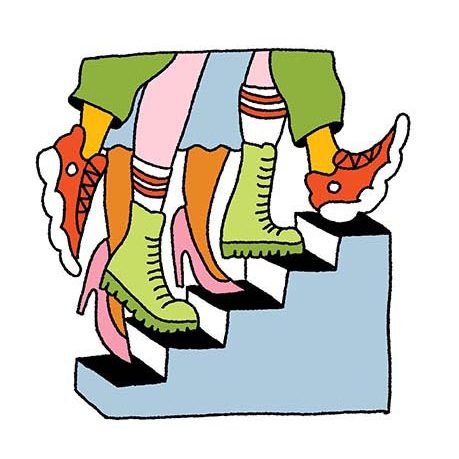
6) Claim: The stairs leading to the 1977 L-wing entrance of the Science Complex were designed for women’s gaits.
Rating: Absolutely false
“We have women of all sizes at Wellesley,” says Maheu. “How would that even work?”
7) Claim: One year a bored student working in the housing office decided to put all of the students named “Sara(h)” together in Dower, a (currently unused) dorm on the East Side.
Rating: At least partially true
“Yeah, I was surprised to hear this is now considered a Wellesley myth,” says Sarah Whedon ’99, “because this is a very real thing that happened.”
Sara Proman Strand ’99 says when she moved into Dower during orientation, the res staff laughed when she introduced herself. Strand knew that her assigned roommate was Sara DeLong ’99, which she thought was kind of funny, but only as she walked down the hall and saw the other names on the doors did she realize the joke. Strand, who grew up in Minnesota, was the only Sara(h) in all of her classes until she came to Wellesley, and then, suddenly, she was surrounded. According to the alumnae directory, 25 members of the class of 1999 are named Sara(h). In fall 1995, when they were first-years, 11 of them were assigned to live in Dower. (It is unknown whether this was done on purpose or just a fluke.)
“It was an easy icebreaker,” Strand says. “When you said your name, people would be like, ‘Oh, do you live in Dower?’ And then you were off to the races, because everyone wanted to hear about it—wait, is that really true? Oh, hell yes, it’s true.”
Since Dower housed only 36 students, it was pretty obvious that a third of its residents had the same name. On the first floor, in addition to Strand and DeLong, were Sarah Reinertsen ’99, Sarah Kim ’99, Sarah Rowley ’99, and Sarah Shaw ’99; on the second floor were Whedon, plus Sarah Rosen ’99, Sarah Parrott ’99, Sarah Michet ’99, and Sarah Moughty ’99. To distinguish between the Sara(h)s, Dowerites established many nicknames: Whedon was “Swhedon” because of her email username; Parrott became “Putney” because she was from Putney, Vt., and always wore a hat with her town’s name on it.
“I actually didn’t respond to Sara for a while,” says Strand. “If somebody said Sara, I just assumed that they weren’t talking to me.”
There were so many Sara(h)s that on dorm crew that year, Dower had two boats—a Sara(h) boat, and a non-Sara(h) boat.
“It’s a funny story to tell now, especially as my older kid is in college and my younger one is finishing his junior year of high school. Now people mostly pick their own roommates by meeting people on some random Instagram site,” says Strand. “There’s nobody sitting in a housing office, doing what happened to us in the ’90s.”

8) Claim: Wellesley’s dorms are haunted.
Rating: Unproven
When I moved into Claflin in August 2006, one of the first things I learned was that my new home had a ghost. I was told her name was Alice, and she had been the daughter of the dorm’s architect. She died tragically during the construction of Claflin, some wise upperclasswoman told me, my first-year eyes wide. That’s why there are those Alice in Wonderland carvings in the common room—they’re in her honor. While I never had an Alice sighting myself, I did often have the distinct feeling of someone watching me whenever I was studying late in the Claflin living room, the wooden eyes of the Queen of Hearts staring at the back of my neck.
Jane Simmons has been a custodial supervisor for maintenance services at Wellesley since 1987, overseeing all of the residence halls. She’s heard stories about a gentleman dressed in period costume in the Beebe dining hall (when it was still operational), rumors about the Tower basement, and she herself experienced doors suddenly slamming in the tunnel that connects Bates, McAfee, and Freeman. But by far, she says, the majority of the dorm ghost stories are from Claflin and Severance.
About 15 years ago during Wintersession, when heat and electricity had been turned off at some uninhabited dorms, Simmons got a frantic call: “A couple of my custodians were working in the basement of Severance, and they said, ‘We are not working here anymore! We have to get out of here!’” The custodians had heard giggling and “some feet running up and down the ramp, down by room 110,” she says. Hairs on their arms raised, the custodians refused to work in Severance again until the lights were back on.
Simmons has also heard the tale of Alice, though in her version Alice was the daughter of the Claflin housemother (precursor to heads of houses, residential directors, and, now, community directors), and she died because a beam fell on her during construction. “She’s a 5-year-old girl,” explains Simmons, “and she comes out when it’s quiet and dark and likes to cause mischief.” One summer, when Sherman Cowan was the Claflin community director, Simmons had her team cleaning the dorm rooms. “After we clean, we shut the windows, because if you don’t, then pollen and dirt comes in,” says Simmons. “But the next morning, my custodians came in and 90% of the windows were open.” Simmons called up Cowan: “I said, ‘Sherman, are you opening the windows because you’re hot?’ Because his apartment was in there. And Sherman goes, ‘Jane, I didn’t open any windows.’” So Simmons went to campus police, and they checked the OneCard swipe history, and no one had swiped in or out overnight. “So that Friday, we made sure all the windows were closed for the weekend—and, yep, when we came in on Monday, they were all open.”
Rania Bartick, Wellesley’s senior project manager for planning, design, and construction, says she didn’t know anything about Alice when she started overseeing the recent renovation of Claflin, until one day last summer when one of the contractors asked if she believed in ghosts.
“No construction had started, but they were bringing the subcontractors up to the attic to look at all the infrastructure,” says Bartick. The Claflin fifth floor rooms were vacant and locked, and the only people coming and going were construction workers. But one day, one of the contractors unlocked the door to the attic from the fifth floor, and sitting right at the door, facing him, was a doll. Bartick insisted that students must have somehow gotten in and were messing with them—she reports having found all kinds of things squirreled away in crawl spaces and under eaves—but the contractor insisted otherwise.
Anna Ehrlich ’18, the senior community director of Claflin, is not fazed: “Alice is just a nice little girl who has a great sense of humor.”
E.B. Bartels ’10 is a senior editorial writer in Wellesley’s Office of Communications and Public Affairs. She hopes the ghosts in Diana Chapman Walsh Alumnae Hall are not too mad at her for being left out of this story.


Post a Comment
We ask that those who engage in Wellesley magazine's online community act with honesty, integrity, and respect. (Remember the honor code, alums?) We reserve the right to remove comments by impersonators or comments that are not civil and relevant to the subject at hand. By posting here, you are permitting Wellesley magazine to edit and republish your comment in all media. Please remember that all posts are public.