
When your home burns down, I hope you have some warning. I hope you can collect the things you’ll need (passports, deeds, birth and marriage certificates) and the things you’ll want (clothes, heirlooms, photographs, art) and enough underwear. (Take the good bras, just trust me on this.) I hope your pets are packed in the car, and your children are away at school or visiting friends, or that if they’re with you, you can comfort one another (if they’re old enough to know what’s happening, not just sensing that something’s gone wrong). I hope you’ve taken pictures of all the belongings you have to leave behind: everything on the walls and bookshelves, everything in the desks and drawers. The silver passed down through your family, your wife’s fancy knife collection, the three little hand-pinched pots your favorite English professor gave you a few years after you graduated. You know, for example.
When our 100-year-old home in Altadena, Calif., burned in the Eaton Fire this January, we were in a hotel room three miles away, trying not to assume the worst as we watched news footage of the fire spreading, whipped from building to building by the Santa Ana winds. We had left before there even was a fire, actually, for fear that the winds would bring our neighbor’s oak tree down on our roof. We didn’t want to be there with our dogs and daughter if that happened, especially in the dark. We had awoken to insane winds early that morning and Edward, the hyperlocal weatherman whose predictions had a habit of being freakishly accurate, had warned our community Facebook group, “We ain’t seen nothing yet.” That afternoon, my wife and I quit work early and booked a hotel. We went to my mom’s accessory dwelling unit in our backyard and convinced her to spend the night at my sister’s place. She didn’t want to go. Said she’d stay and keep an eye on things. We harassed her into it. Funnily (?) enough, her converted garage is one of the only buildings still standing on what used to be our green residential street. It’s kind of melty and uninhabitable, but it’s there, with her half-finished jigsaw puzzle on the table.
When the electrical tower caught fire four miles from our house, L.A. County’s firefighting resources were already stretched too thin, fighting the flames decimating the Pacific Palisades across town. Their helicopters were grounded by the winds. And by the time the Eaton Fire jumped a main artery and headed toward our neighborhood, the firefighters weren’t even trying to save houses anymore. Supposedly they didn’t have enough water pressure in the hydrants to even try. My friend Nancy watched her house burn live on TV for six hours, from start to finish, with no intervention.
I want to believe nobody’s to blame, but I think there are ultimately quite a few people on the hook. Whoever made the call not to turn off the power lines. Whoever neglected to send evacuation orders to most residents of West Altadena, where nearly every death occurred, until many hours after the fire had reached our streets. A lot of people died in the dark between January 7 and 8, and most of them probably didn’t even know the fire was coming for them. They were asleep.
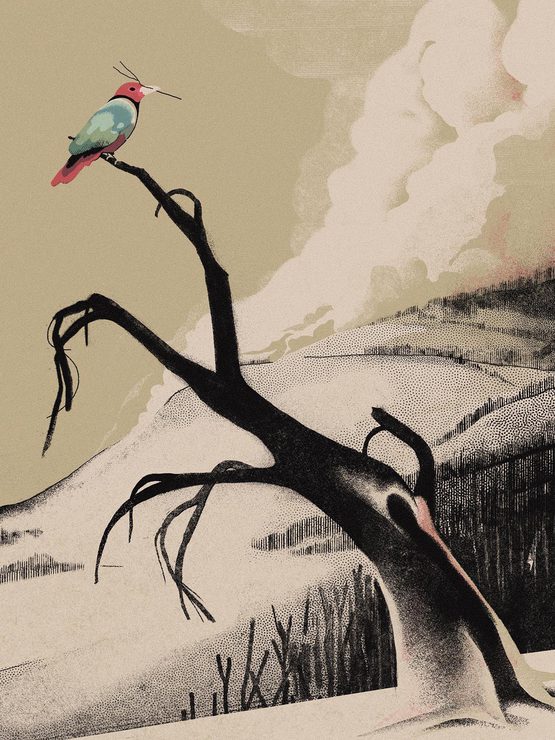
My family is OK. We were scared of the wind.
My family is OK. We have resources like insurance, employment, and a GoFundMe. (Not to mention an extensive network of people—including Wellesley siblings—who cared enough to donate to it.) Near strangers offered us a short-term place to stay near my daughter’s unburned day care. Then we found a rental that takes dogs. It’s fine. We’re OK the way you say “OK” when there’s too much to explain and you’re mostly, you know, better than you could be.
But a lot of our neighbors are not OK. They are retirees unprepared to rebuild. They are film industry folks already hurting due to Hollywood’s contraction and the strikes. They are Black families disproportionately affected by the fire due to the legacy of redlining, whose hard-earned generational wealth burned up with their homes.
We are pretty much all underinsured, and for those who are still eager to rebuild, we’re facing the prospect of doing it during an unprecedented tariff fiasco courtesy of a guy we mostly didn’t vote for. While FEMA grants are cut. While many of our families are under attack by our own government.
That’s a lot. I know.
Should I look for a silver lining at this point in the essay? I think we deserve it. This is an alumnae magazine, after all, and even eulogies benefit from a few well-placed jokes. Let’s find some levity, people!
Hmm. Huh. Well.
<<Insert writing break where I drink more wine.>>
OK! I got it! One good thing that came out of this: Now you know about Altadena. It was a very special place inhabited by artists and families and weirdos who loved its cowboy spirit. We had a working phone booth in the middle of a hiking trail. We had horses and chicken coops and pet tortoises. My neighbors’ tortoise named Shelly Duvall was hibernating during the fire, and after their street burned down, a local wildlife rescuer dug Shelly up, and she is fine.
If you’re reading this and have some savings and a burning (Hah! There’s the levity!) desire to move to a place near L.A. that doesn’t feel much like L.A., consider buying land from someone who can’t build back. We want families. We want creatives and oddballs and people willing to dig up their neighbors’ tortoise. We want queers and immigrants, not developers and investment firms.
While it upsets me to think of who we’ll lose and how long it may take to be at home again, I remind myself that actually most of the houses on my block were built around the same time, 100-ish years ago. Which means the residents were all building together back then, too.
We’re just going to have to do it again. I hope it’ll be better than OK.
Lynn Sternberger ’07 is a television writer in Los Angeles.To learn about Altadena recovery efforts, visit the Altadena Builds Back Foundation at https://pasadenacf.org/altaden....


Post a Comment
We ask that those who engage in Wellesley magazine's online community act with honesty, integrity, and respect. (Remember the honor code, alums?) We reserve the right to remove comments by impersonators or comments that are not civil and relevant to the subject at hand. By posting here, you are permitting Wellesley magazine to edit and republish your comment in all media. Please remember that all posts are public.