
As a child, Lamiya Mowla ’13 did not turn her eyes to the heavens.
“I didn’t grow up looking at stars,” says Mowla, who since fall 2023 has been an assistant professor of astronomy at Wellesley. “Because I grew up in Dhaka, in Bangladesh, right in the middle of the smoggy, light-polluted city, I do not remember seeing any star.” That changed when she arrived in the United States for college. “[Wellesley] was the darkest place that I’d ever been to at that point,” she says.
But the telescopes in the College’s storied Whitin Observatory, now celebrating its 125th year, opened the heavens to Mowla, today a rising star in observational astronomy.
Mowla came to campus planning a career in neuroscience. But fate took a hand when she didn’t get into the chronically over-enrolled NEUR 101: Introduction to Neuroscience her first semester. She wandered into the fall academic fair and heard the legendary Dick French, Louise Sherwood McDowell and Sarah Frances Whiting Professor of Astrophysics and professor of astronomy (now emeritus). He was speaking about stellar evolution, “the life of stars and them blowing up and turning into supernovae and becoming black holes,” Mowla recalls. “That’s fascinating, right?” She signed up for French’s introductory astronomy class and “absolutely fell in love.”
As a lab assistant for French’s class, Mowla was “always outside with the telescope, looking through the telescope, showing students the constellations.” During her senior year, she took a course in observational astronomy, and Whitin Observatory became her universe.
“I was staying there until sunrise,” Mowla says. She and her observation partner spent every clear night at the telescope, painstakingly collecting 35 hours of usable data. The object of their study was the Andromeda galaxy, the closest large galaxy, located some 2.537 million light-years from Earth.
Kim McLeod, who followed Dick French as Louise Sherwood McDowell and Sarah Frances Whiting Professor in Astrophysics and professor of astronomy, says the seniors’ work was the biggest project ever done with the Fitz-Clark 12-inch refractor telescope, which was built in 1852 by Henry Fitz, reconfigured in 1867 by Alvan Clark & Sons, and refinished and installed at Wellesley in 1900, when the observatory first opened. “Kim was so happy with [the study], and she says that she doesn’t think anyone’s ever going to beat it,” Mowla says, laughing.
In the classroom
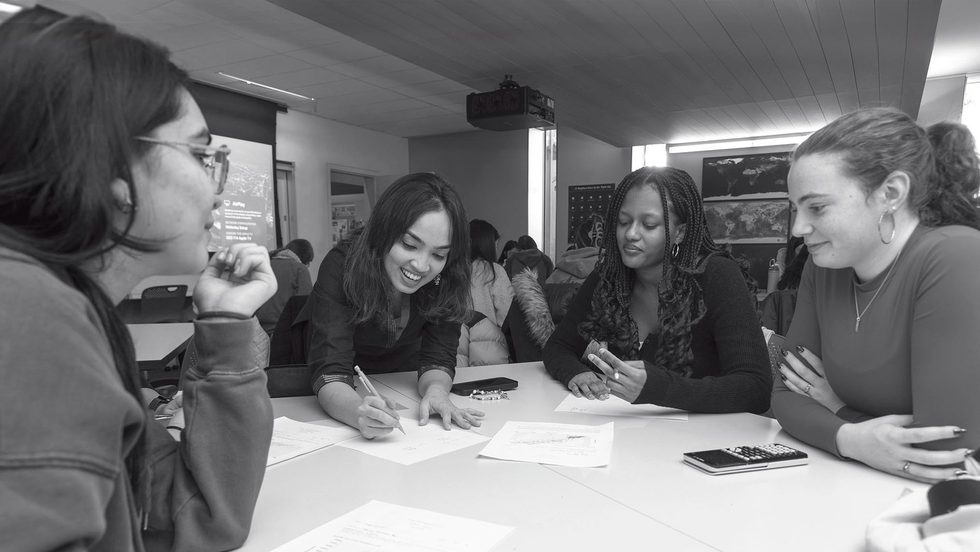
On a fall day in a classroom in Whitin Observatory decorated with star charts and photos of the Andromeda galaxy, Mowla is teaching her ASTR 107: Introductory Astronomy class (which was called Astro 101 when she took it as a first-year) how to figure out the weight of galaxies. Her style is gentle and conversational as she moves among the tables where groups of students work together on the computation. “Find the speed of the circular motion of the Earth,” she says, waving her arms in a circle. “We are never really at rest. We are moving at 20 miles per second, and the galaxy is moving, too. Everything is moving in circles.”
Madeleine Tuck ’29 was one of the students in ASTR 107 in fall 2025. As in Dhaka, it can be hard to see the stars in her hometown of Dallas, she says. But that didn’t stop her from falling in love with the sky. Astronomy has been a thread running through her life since first grade, when she discovered a picture-filled astronomy encyclopedia on her classroom bookshelf. “I loved it,” she recalls. “I think I read it pretty much any chance I could get—well, maybe not read it so much as just looked at the pictures.”
Watching Cosmos: A Spacetime Odyssey with Neil deGrasse Tyson pushed her, as she says, “further into a deep love and borderline obsession with astronomy and astrophysics.” She remembers stepping outside in a remote part of Hawai‘i on a family vacation and suddenly grasping the scale of the sky: “I went outside one evening and I thought, ‘Oh, yeah!’ It was amazing. You could see so many stars.”
When it came time for college, Tuck knew she wanted to go to New England. Discovering Wellesley’s astrophysics major and hearing about the College from a high school friend sealed it. Her first semester was shaped by ASTR 107, which she calls “honestly such a great introduction.” She appreciated the pace—“fast enough that you don’t get bored, and interesting enough that you don’t get distracted”—as well as the chance to work with real telescopes. During night labs, she completed moon observations through binoculars and eventually the 12-inch telescope. “I thought, ‘Oh my gosh, this is what I get to work with,’” she says. Seeing lunar mountains and valleys left her “in awe.”
In late October, Tuck earned her telescope license, meaning she can now head to the observatory on her own. Andromeda has become her favorite target: “When I actually find the guide star, then it’s gorgeous.”
Her enthusiasm has already opened doors. “I was training this semester to join the Wellesley Extragalactic Explorers research team,” Mowla’s research group, she says—and over Thanksgiving break, she got an email from Mowla. “I was invited to join [the team]. I’m really excited.” Being able to do research as a first-year feels extraordinary. “If you went to any big or slightly bigger school, it would be incredibly difficult to do,” Tuck says.
Looking ahead, Tuck’s goals are clear: “Get that astrophysics major, do a senior thesis, and then grad school and beyond.” She hopes to work with Mowla “as long as I can,” she says, because the professor’s research aligns so perfectly with hers.
Galactic discoveries
Through telescope lenses focused on the cosmos, Mowla discovers more than data. “I find astronomy very peaceful,” she says. “Everything in astronomy has already happened. A photon has traveled for a really, really long time. Don’t let it fall to the ground.”
Graduate school at Yale University took Mowla to nights at Palomar Observatory in California and the Keck Observatory in Hawai‘i. In New Mexico, she worked hands-on creating a novel low-cost telescope being constructed by her Yale advisors from 48 high-end Canon telephoto lenses.
“Now, I work with telescopes that are actually much farther away,” she says. Mowla studies the formation and evolution of galaxies since the cosmic dawn using the Hubble Telescope and James Webb Space Telescope (JWST) and cosmological simulations.
Mowla witnessed the beginning of a new era in space exploration in July 2022 from a conference room in Halifax, Nova Scotia, with her University of Toronto colleagues, as NASA livestreamed the first full-color transmissions from the JWST. “When Joe Biden unveiled that image, we were glued to it, watching and watching,” Mowla says. The next morning, the raw imaging and spectroscopic data arrived, and Mowla was among the fortunate astronomers to have access to it.
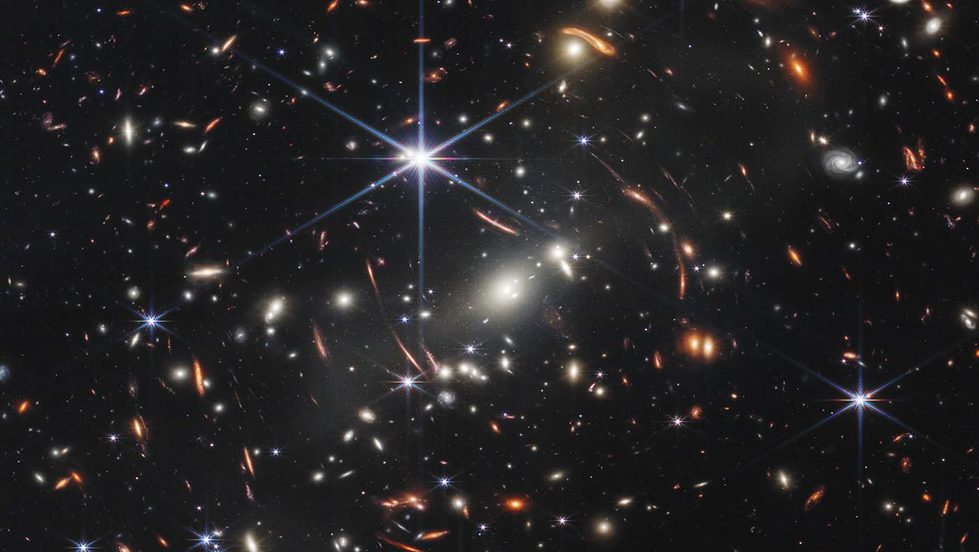
During JWST’s first week of operation in 2022, Mowla and the team from CANUCS (Canadian Near-Infrared Imager and Slitless Spectrograph (NIRISS) Unbiased Cluster Survey) examined an image of the galaxy cluster SMACS 0723, or Webb’s First Deep Field. Amid this treasure trove, Mowla and the team spotted a galaxy with three multiple images, surrounded by bright star clusters, unlike anything they had seen before. They dubbed this galaxy the Sparkler. Members of the team wagered on the nature of the Sparkler: Was it ancient star clusters or newborn ones? “They were like, OK, it’s up to you guys to figure it out,” Mowla recalls. Within two days, she and her collaborators had their answer: “Yes, these are old.” “From data to paper, it was three weeks,” Mowla says. “I don’t think I will ever do that again, but it was also the most exciting time.” Mowla says her advisor told her, “This happens once in a lifetime, that you have a mission that’s launched, and you’re there.”
Their analysis determined that these star clusters may contain some of the oldest stars of the universe, Mowla explained in an interview with the BBC. Their work was published in the Astrophysical Journal and was listed among the most significant findings by the telescope during its first year of operation. “When it comes to more complex structures like this, they’re still identified by the human eye,” she explained in an article in the online journal First Principles.
Since the discovery of the Sparkler, Mowla and her team have been on the hunt for galaxies in the young universe that are being born. Their search led to a galaxy in the CANUCS survey. Six hundred million years post-Big Bang, the Firefly Sparkle galaxy was magnified through gravitational lensing (a foreground galaxy cluster acting like a natural magnifying glass), alongside two companion galaxies named Firefly Best Friend and Firefly New Best Friend, names that reflect the astronomers’ playfulness.
After their observation, the team wrote a paper, “The Firefly Sparkle: The Earliest Stages of the Assembly of a Milky Way-type Galaxy in a 600 Myr Old Universe,” that was published in the prestigious journal Nature.
The Firefly Sparkle galaxy, located 13.4 billion light-years away from Earth, provides a vivid snapshot of the early cosmos. Cocooned in a diffuse arc, and resembling fireflies “dancing” on a summer night, the Firefly Sparkle was taking shape around the same time that our own galaxy was beginning to form.
Mowla says the discovery is particularly important because the mass of the Firefly Sparkle is similar to what the Milky Way’s mass might have been at the same stage of development.
“These remarkable images give us an unprecedented picture of what our own galaxy might have looked like when it was being born,” Mowla says. “By examining these photos of the Firefly Sparkle, we can better understand how our own Milky Way took shape.”
Mowla is now principal investigator for two JWST projects: one for follow-up spectroscopy of the Sparkler galaxy, already completed, and another full observation of the Firefly Sparkle galaxy happening this year.
At Wellesley, Mowla has distinguished herself at “every step,” says Dick French, ultimately securing a coveted project on the James Webb Space Telescope, to which access is extremely competitive. “Her program is a very, very imaginative one,” says French. “It’s going to be looking at the very early universe, when stars were just being formed.”
He adds, “it’s also singular that she’s the principal investigator, offering external recognition for her as really a wonderful scientist while giving undergraduate students an opportunity to get connected with somebody who has wonderful data.”
Mowla represents “the next generation of scientists at Wellesley who are involving students in research,” he adds. “There are probably a lot of places that would like to have her as a faculty member; Wellesley is lucky to have her.”
“What you can do as an observer of the cosmos is bask in how beautiful it is, and also try to tell its story.”
Global concerns
In addition to research and teaching with telescopes, Mowla is deeply engaged in investigating the non-Western history of science. As a graduate student at Yale in 2020, she began looking for female astronomers of color to quote in her thesis. “I couldn’t really find the resources,” she says. To Mowla, as a South Asian Muslim woman, that absence felt personal.
When she arrived at Wellesley as a professor, she began a multiyear project with her students, recovering the lives and stories of women astronomers around the world and across history. They have now identified about 15 women, “dating as far back as 2500 B.C.,” Mowla says. One is Enheduanna of Mesopotamia; another, from 10th-century Baghdad, is Al-‘Ijliyyah or Mariam al Astrulabi, which means “Maria, the astrolabe maker.” Al-‘Ijliyyah was said to be a craftswoman of scientific instruments, though the record is foggy, and some scholars argue she never existed. Mowla and her students were determined to find out. Her independent study research student Peirong Vivi Li ’26, a history major, who took ASTR 107 to fulfill her lab requirement and has been working with Mowla for the last two years, finally found the proof. In collaboration with the librarians at Clapp, Li was able to find the translation of the 10th-century book Al-Fihrist, which catalogues the names of scientists, artists, and makers from the era. Deep in its pages, Li discovered the name of Al-‘Ijliyyah, a proof that she existed.
In 2024, Mowla received support from the Paulson Ecology of Place Initiative for the project. Then, in fall 2025, she received additional funding through a grant from the Faculty & Research Incubator Program of the Susan L. Wagner ’82 Centers for Wellesley in the World. The Wagner Centers, comprising the Madeleine Korbel Albright Institute for Global Affairs, the Wellesley Centers for Women, and the Hillary Rodham Clinton Center for Citizenship, Leadership, and Democracy, is a campus hub for research and global solutions, especially on critical issues related to women, democracy, and gender equity. The incubator program provides researchers with seed funding for public-facing efforts that translate academic findings into accessible formats for the common good.
Mowla’s project is composed of two distinct, yet mutually reinforcing, initiatives that will significantly advance global women’s leadership in astronomy, coinciding with the celebration of the 125th anniversary of Whitin Observatory. The first, “Recovering Erased Histories of Global Women Astronomers,” involves the creation of a permanent exhibition and a corresponding digital archive. These resources will focus on recovering the forgotten histories of non-European women astronomers, translating two years of intensive student-led research into a publicly accessible scholarly tool.
The second initiative is an annual winter school in astrophysics at the Asian University for Women in Bangladesh, where Wellesley students teach and collaborate with peers from conflict-affected and under-resourced regions across Asia. The next gathering is scheduled for this June. Together, these initiatives connect Wellesley’s legacy to a global movement for inclusive excellence and leadership in science.
Mowla was also one of the founding members of the first astrophysics research center in Bangladesh, the Center for Astronomy, Space Science, and Astrophysics at the Independent University, Bangladesh. The center is home to the only astronomy major and master’s program in the country. In addition to her group at Wellesley, Mowla runs a second research group in Bangladesh with undergraduate and master’s students.
Mowla’s research about non-Western women astronomers is as cultural as it is historical. “We were like, why can’t we find any African figures? Why can’t we find a Polynesian figure?” Mowla says. Colleague Banu Subramaniam, Luella LaMer Professor of Women’s and Gender Studies, offered an answer: In many non-Western scientific traditions, knowledge belonged to communities, not individuals. “In many cultures, the community as a whole has preserved the culture of knowing the stars,” Mowla says.
Her life outside the classroom is quiet, Mowla says. She enjoys painting (“I’m not very good at it, but it calms me”), and her cat, Dora (the Explorer), who comes to her office at the observatory with her, and playing Stardew Valley with her husband, a biophysicist she met in graduate school at Yale.
Meanwhile, she and students like Madeleine Tuck keep their eyes on the sky. “What you can do as an observer of the cosmos,” Mowla says, “is bask in how beautiful it is, and also try to tell its story.”
Catherine O’Neill Grace, the daughter of a U.S. Foreign Service officer, first glimpsed the enormity of the Milky Way against a truly dark sky when she was a small child visiting the Himalayas with her family.
The View Above

An image of the Andromeda Galaxy from the Hubble Space Telescope

Face-on barred spiral galaxy, NGC 1512, is split diagonally in this image: The James Webb Space Telescope’s observations appear at top left, and the Hubble Space Telescope’s on bottom right.

Madeleine Tuck ’29, a member of the Wellesley Extragalactic Explorers team, with Mowla

An image from the James Webb Space Telescope shows the galaxy nicknamed the Firefly Sparkle


Post a Comment
We ask that those who engage in Wellesley magazine's online community act with honesty, integrity, and respect. (Remember the honor code, alums?) We reserve the right to remove comments by impersonators or comments that are not civil and relevant to the subject at hand. By posting here, you are permitting Wellesley magazine to edit and republish your comment in all media. Please remember that all posts are public.