
Entering the Museum of Fine Arts, Boston (MFA) today past the columns of the Huntington Avenue entrance, visitors will notice a new pair of brilliant platinum-coated sculptures, “The Knowledge Keepers” by Alan Michelson, honoring Massachusetts’ Indigenous nations. Behind the beaux arts façade, other big changes are afoot. Last summer, the museum welcomed a new director, and the staff is currently revamping many of its permanent galleries, in response to trends in scholarship and attendance. Wellesley has long-standing connections to the museum, from early faculty collaborators to Rita Freed ’74, chair emerita of the Department of Ancient Egyptian, Nubian, and Near Eastern Art (see Wellesley’s LinkedIn page for a profile of Freed). Today, three Wellesley grads are among those leading changes at the MFA—curators Claire Howard ’05, Erica Hirshler ’79, and Christina Yu Yu ’02.
Make it modern
On a cold, gray day this past fall, the newly opened 20th-century sculpture gallery glowed. What used to be a gift shop and an HVAC closet now boasts fresh white walls and a pale gray terrazzo floor, highlighting works by household names like Picasso and luminaries like Isamu Noguchi. “People who have been here a long time are just like, ‘Wow, this space really got a glow up,’” said Claire Howard ’05, the inaugural Hansjörg Wyss Curator of Modern Art, as she showed me around.
The sculpture gallery opened in June 2025—almost nine months after Howard arrived—and it is one of five new galleries dedicated to modern art to open last year. Howard had previously been associate curator at the Blanton Museum of Art at the University of Texas at Austin, where she earned her Ph.D. Moving to the MFA was her dream job. “It was so nice to go back to the museum that meant a lot to me as a student,” she said.
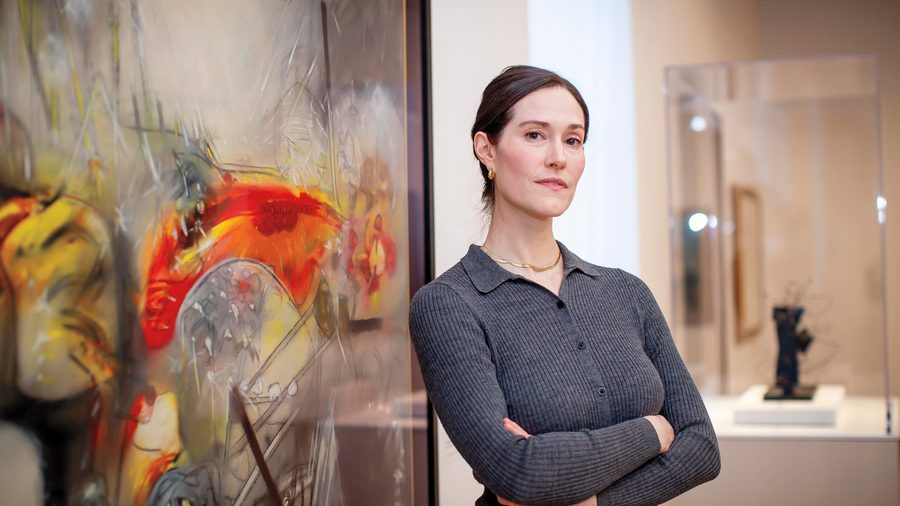
Howard’s position was created by a major gift intended to beef up the museum’s representation in modern art, roughly defined as work from the late 19th century through the mid-20th century that rejected traditional representational techniques. Although the MFA has many modern gems, it did not collect as actively in the first half of the 20th century as comparable institutions. “At this point, we’re not going to be able to be MoMA,” Howard explained, acknowledging the high cost of modern art. The week we met, a Gustav Klimt portrait sold for a record-breaking $236.4 million. “But what can we do that’s different? What can we do that shows how our understanding of 20th-century art has changed in the past few decades?” Howard asked.
The answer, she said, is to think globally and thematically, rather than follow the traditional chronological or geographical march through history. One of Howard’s new galleries ties together works by artists including Paul Gauguin and Piet Mondrian under the theme of “Color and Spirituality.” In another, she offers a fresh take on surrealism (her academic specialty), highlighting paintings by René Magritte and Cuban artist Jorge Camacho, whose Ascendant licorne: le scarabée (1973) was her first major purchase for the museum.
Howard said thinking creatively within constraints is one of the thrills of the job, as well as one of its challenges. “Curators always want to think big and plan a ‘dream show,’” she said, “but something I really like about this field is that you’re working with physical objects that have to move through time and space. You may want a particular painting, but it’s owned by someone who refuses to lend it, or it’s in Australia and it would cost $50,000 to ship it.” (Howard shared a personal anecdote about moving physical objects through space and time that involved her and a painting, a Venetian barge, and a high-speed van ride to Rome that sounded like something out of a Hollywood film.)
Inevitably, when a curator pulls together a gallery, the objects themselves reveal unexpected connections. Standing in the sculpture gallery, Howard drew an invisible line with her finger, connecting Simone Leigh’s No Face, Pannier (2018) to Max Ernst’s The King Playing with the Queen (1944) and through the door into the Sidney and Esther Rabb Gallery of Impressionism and Post-Impressionism in France to Degas’s famous Little Fourteen-Year-Old Dancer (original model 1878–81, cast after 1921). Although separated by centuries and nationalities, artistic styles and concerns, connections emerge: Degas and Leigh both use traditionally non-sculptural materials (gauze for Degas, raffia for Leigh) for their figures’ skirts; the Ernst and Leigh figures both have their arms akimbo. “You don’t really think about these things planning the installation, but then once you’re installing a show, there are inevitably these little moments of things pinging off of each other that you couldn’t have planned for,” she said.
A new look at the Americas
“Everything is coming out,” said Erica Hirshler ’79, beaming with excitement, as we stood inside the main floor of the Art of the Americas galleries a few weeks before they closed for reinstallation. “Then a lot of it is going back in, but it’s going to go back in differently.” For the first time since this wing of the museum opened in 2010, the eight central galleries are getting a bold new look, and Hirshler, the Croll Senior Curator of American Paintings, is lead on two of them.
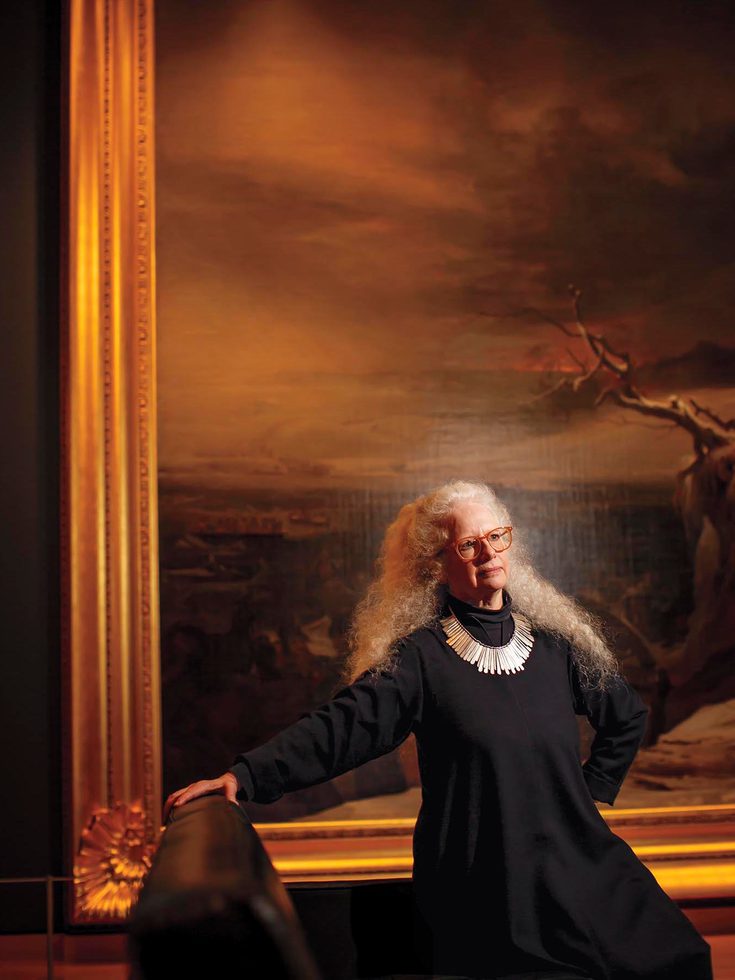
Hirshler has been at the MFA longer than almost anyone on staff. She began working at the museum in 1983 while a graduate student at Boston University, and she has worked her way to the top of the curatorial ladder, a rarity in a field that increasingly requires people to move out to move up. Over those 40-plus years, she has made a name for herself curating blockbuster traveling exhibitions such as 2023’s Fashioned by Sargent, which paired John Singer Sargent’s portraits alongside the exquisite actual period garments and accessories depicted in the paintings. Hirshler is also a prolific writer—not all curators are—and she has published more than a dozen books and many more chapters.
When the galleries reopen in June, they will reflect movement and exchange between cultures of the 18th and early 19th centuries, showing more Latin American works, including important recent acquisitions such as a Mexican folding screen made in imitation of Chinese lacquer. Several will be organized thematically. In the “History and Mythmaking” gallery, where Hirshler is the lead, she stood in front of the famous Thomas Sully painting of George Washington, The Passage of the Delaware (1819). “The Sully is, to be honest with you, too big to move,” she explained. At roughly 12 feet by 17 feet, it’s not hard to see why. But the new arrangement will group it with similar paintings of historical figures along with text that asks the viewer to ponder how such images are manufactured.
“How do you make a hero?” she asked. “You make him look like that.” Hirshler waved at Washington’s confident pose astride a white horse, bathed in a singular halo of light. “In fact, the passage of the Delaware was an incredible effort of multitudes to make it work, and a lot of the figures who participated in it were Black and Indigenous, and you’re not seeing them,” she continued. “This is a moment when there’s a lot of talk about ‘fake news’ and fake images, but every image is constructed. If I can get people to understand that images have a purpose, and who they show and how they show them is a construction, I’ll think it’s a huge success.”
Having been instrumental in the creation of these galleries 15 years ago, Hirshler might be expected to be wedded to their organization. On the contrary, the renovation fills her with enthusiasm, even though she has several other big projects on the go. Last fall she was writing entries for the new MFA publication that will accompany the reinstalled galleries, as well as a catalogue essay for the major traveling exhibition she is helping to organize on Mary Cassatt. “Cassatt as Independent” will open in October 2026 at the Musée d’Orsay before traveling to London and finally to the MFA in 2027.
Over a long career, Hirshler has never lost the thrill she experienced in the very beginning. She remembers the day she walked into an empty gallery to help hang her first exhibition at the MFA. “All of a sudden, everything that I had ever studied in school was on the floor in front of me,” she said. “Copley, Sargent, Cassatt—they felt like they were familiar friends instead of just pictures in formal galleries. I still love that part.”
Asia reimagined
Across the museum in the Art of Asia wing, I meet Christina Yu Yu ’02. She appeared diminutive beside the monumental sculptures of the Japanese Buddhist Temple Room, yet she is a towering figure at the MFA, where she is Matsutaro Shoriki Chair of the Art of Asia, a leadership role she assumed in 2018, when she was not yet 40. Previously, Yu had been the director of the USC Pacific Asia Museum, another extraordinary leadership position for such a young curator.
Yu’s department is one of the museum’s oldest and largest. About 20% of the MFA’s collections fall under her purview, which includes works from Japan, China, Korea, South and Southeast Asia, and the Islamic world. The Japanese collection, part of the museum since its opening in 1876, is particularly strong. “We have the largest—and we like to say the best—collection of Japanese art outside of Japan,” she said. Many pieces, like the sculptures in the temple room, would be considered a national treasure if they were still in Japan.
The Japanese galleries have recently received a makeover, and several more are under construction, scheduled to reopen beginning in 2027. The last time these galleries were renovated was 40 years ago, and since then, the department has made many new acquisitions. “For most people, we are known for our pre-modern material, but actually our curators have been very actively collecting modern and contemporary objects to tell the full story of Japan and Japanese art,” she said.
Contemporary pieces are now threaded among earlier works from the eighth through the 19th centuries. At the entrance to the Japanese gallery sits a porcelain sculpture covered in cross-hatching by Kondō Takahiro, Reduction, Self-Portrait (2015), depicting a man in the same lotus pose as the Buddhas across the room. Likewise, a large display case portrays an entire Japanese tearoom that features a mixture of old and new: a 19th-century hanging scroll as well as a more contemporary silver tea service—“because the tea ceremony is an artistic tradition that continues to this day,” Yu explained.
As head of a department, Yu has a more managerial than curatorial role, overseeing a team of seven curators and frequently meeting with donors and visitors. Part of her job is hosting foreign delegations, scholars, and museum professionals. In addition to English and Mandarin, her mother tongue, Yu also speaks Japanese, and she travels regularly to Asia, although just days before we met, she was in London on a curators circle trip, accompanying the museum’s financial supporters and collectors on a tour of the fall art fairs and auctions. The day I interviewed her, she also fit in a studio visit with a local new media artist to help her keep abreast of trends in art and build connections within Boston’s art community.
Interacting with people is now one of the highlights of her job. “When I first came to the field, I was very attracted by the art objects, which are hundreds, even thousands of years old,” she said. “As a curator, you have a chance to study them and even touch them. There’s just something so magical about that. But the more time I spend in the museum, I have really come to love working with people, because everyone responds to objects differently.” Yu pointed to a display case of Japanese tea ceremony and observed, “Someone will say to me, ‘Oh, that reminds me of something in my grandma’s house.’ It wasn’t treated as an object but as a living thing.”
“I have really come to love working with people, because everyone responds to objects differently. Someone will say to me, ‘Oh, that reminds me of something in my grandma’s house.’ It wasn’t treated as an object but as a living thing.”
A foundation in the arts
From its beginnings, Wellesley’s art department has been one of the College’s strengths. In 1900, Alice Van Vechten Brown, head of the department and director of the College’s museum, established the first art history major in the country at Wellesley, and a key innovation of what became known as the Wellesley Method included a studio art practice alongside direct observation at art museums, including the MFA.
Today the art department continues to be at the forefront of the discipline. Beginning in 2015, the long-running two-course introduction to art history sequence was replaced by a one-semester seminar-style course organized around a series of questions and case studies. Patricia Berman, Theodora L. and Stanley H. Feldberg Professor of Art, who has taught the course for decades, explained: “Recognizing that student needs were changing, that pedagogy was changing from large-auditorium lectures to interactive seminars, and that the department wanted to offer a more globalized and critical course, members of our department proposed a major overhaul.” Yet some things remain the same. “The Davis Museum continues to be a laboratory for exploration and the Museum of Fine Arts our off-campus focus,” she said.
All three curators cited their education at Wellesley as foundational in their decision to enter the field. Howard enrolled in the introductory course her first year because of her mother’s insistence that art history was “essential knowledge for being a person in the world,” she said, yet she enjoyed it so much, she added art history as a second major in addition to English and went on to complete independent studies with both Berman and Bill Cain, Mary Jewett Gaiser Professor of English. A paid, yearlong internship in the Davis Museum’s print study room made her certain she wanted to work in an art museum.
Hirshler arrived at Wellesley in the 1970s specifically planning to not study art history. Her father was an art history professor at Denison University in Ohio. “Art was what we did,” she said. “Other families went to the Rockies, we went to museums and cathedrals.” But studying with James O’Gorman, Grace Slack McNeil Professor of Art, who taught at the College from 1975 to 2004, she became captivated by American art. “I fell in love with it and took everything he had to teach while I was there,” said Hirshler. “I really feel that I’d found my calling.”
Art history was not taught at Yu’s high school, in the Chinese city Wuhan, but Wellesley’s liberal arts curriculum required her to sample a wide variety of classes. Like the other two curators, Yu vividly recalls her student visits to the MFA. Before I departed, she took me to see the 11th-century Indian stone bodhisattva she wrote about for her first formal analysis paper. “This was the beginning of my introduction to art history,” she said, tracing the sinuous curves of its pose and decorations. “My whole career, in a way, started with this.” Today the statue is in the collection of Yu’s own department, where it is no doubt visited by many current Wellesley students, and perhaps some of the MFA’s future curators.
Sarah Ligon ’03 is a writer and educator living in Oxford, Miss. She loved every art class she took at Wellesley, including ART 101, and never misses a chance to visit the MFA—or any other art museum.


Post a Comment
We ask that those who engage in Wellesley magazine's online community act with honesty, integrity, and respect. (Remember the honor code, alums?) We reserve the right to remove comments by impersonators or comments that are not civil and relevant to the subject at hand. By posting here, you are permitting Wellesley magazine to edit and republish your comment in all media. Please remember that all posts are public.