
Growing up in conservative central Pennsylvania, I assumed I would be a mom of two kids, likely by age 30. That’s not what happened.
As a Wellesley student in the early 2000s, I didn’t think much about marriage or kids, except when I organized a class gift for Professor Courtney Coile (now provost and Lia Gelin Poorvu ’56 Dean of the College) when she had her first child. I remember standing in the Natick Mall thinking it was easier to do a problem set than figure out what to buy for a baby.
After Wellesley, I pursued graduate school and threw myself into the work world. I didn’t get married until my mid-30s, and then I got divorced. I ended up having a daughter on my own as a single mom by choice at age 40. I briefly contemplated having a second child, but I decided to be “one and done” as the rigors of solo parenting set in. I even modeled on a spreadsheet how much a second child would cost and cried as I realized having another kid would delay my retirement by a decade.
My story is illustrative of a great societal shift that has taken place in the past half century. Women in nearly every nation are having fewer children or none at all. The fertility rate in the United States is now at an all-time low of 1.6 children born per woman, well below the 2.1 average needed to ensure the population remains the same. In the United Kingdom, the rate has dropped to 1.4. In South Korea, it’s a mere 0.72. At this rate, there will be just 13 grandchildren for every 100 South Koreans currently in their reproductive years.
From the White House to Beijing, politicians portray this as a crisis that will bankrupt nations, shrink the population, and harm society. To combat the trend, there are increasing attempts to get women to marry earlier and have kids. Some nations are giving out “baby bonuses.” Others are trying to make life easier for parents with longer parental leave and subsidized child care. There are even those sponsoring mass weddings or publicly castigating women who don’t have kids. Vice President JD Vance famously quipped that Democratic women are “childless cat ladies who are miserable at their own lives.” The backlash was swift.
There’s still a lot of debate about why fertility rates are declining. The simple explanation is women finally have choices in life. They have access to birth control, egg freezing, and other medical advances that give them freedom to choose when—or if—they want children. Teen pregnancies and unplanned pregnancies have plummeted, while the number of women pursuing higher education and careers has soared. The result is that people are settling down later in life and having fewer kids.
But it’s complicated. As I spoke to Wellesley professors and alums from different eras, I found that every life story is nuanced. Yet common themes emerged. Over and over, people mentioned how rising costs, health issues, struggles finding a life partner (especially one who would be a true co-partner at home), and a general sense of unease about where the world is headed, environmentally and politically, shaped their life’s trajectory, especially regarding whether to have a child.

Why it’s happening
Phillip Levine, the Katharine Coman and A. Barton Hepburn Professor of Economics at Wellesley, has spent decades researching changing fertility rates. He was early to recognize the big decline in teen pregnancies in the U.S. and the impact that the MTV reality show 16 and Pregnant, which began in 2009, had on that drop. In a recent paper, Levine proposes one overarching reason U.S. fertility is falling in every industrialized nation: It’s what he and his co-author, Melissa Schettini Kearney, call “shifting priorities.”
There’s a “widespread re-prioritization of the role of parenthood in people’s adult lives,” Levine and Kearney wrote in a working paper released by the National Bureau of Economic Research in 2024 and updated last summer. It reflects “a complex combination of factors leading to ‘shifting priorities’ about how people choose to spend their time, money, and energy.”
That shift has played out over the past 75 years. In the late 1950s, American women were giving birth to nearly four children, on average, in their lifetime. By 1970, that had fallen to 2.5 kids. For much of the 1980s, 1990s, and 2000s, fertility hovered around two children. Then it slipped again, as the Great Recession hit in 2007. It has never recovered.
The millennial generation—my generation—is a tipping point. Born in the 1980s and 1990s, millennials were raised on Disney’s “happily ever after” movies and a family-friendly TGIF lineup on TV with shows like Family Matters. But as we arrived in college, Sex and the City exploded in popularity with characters such as Samantha Jones openly shunning marriage and kids, offering a new way to define a meaningful and fulfilled life. No one would label Jones a “spinster.”
Millennials and late Gen Xers also faced the Great Recession just as their careers were taking off and they were in their prime childbearing years. It caused many people to delay having kids. For some, it resulted in fewer children than they had hoped for or expected.
Lindsey Woodson Vick ’99 met her husband when they were teenagers. They married in 2004 and talked frequently about how they loved growing up in larger families and wanted to have three kids. Their son was born in 2006 and their daughter in 2010. Life seemed to be on track, but then “adulting happened.” Vick quit her job in 2010 to start her own business, Sunflowers Healing and Wellness, in the Washington, D.C., area. She helps people on their fertility and birth journey. The majority of her clients are first-time parents in their late 30s or 40s.
It took two years for her business to become profitable, and her husband lost his job due to downsizing only a few days after Vick quit hers to launch the startup. As they looked at their finances, they couldn’t shake the feeling that it wasn’t possible to have a third child.
“I grieved that for several years. We made the conscious decision that our family was complete. It was so hard,” Vick says. “I wish circumstances had been different in our late 30s.”
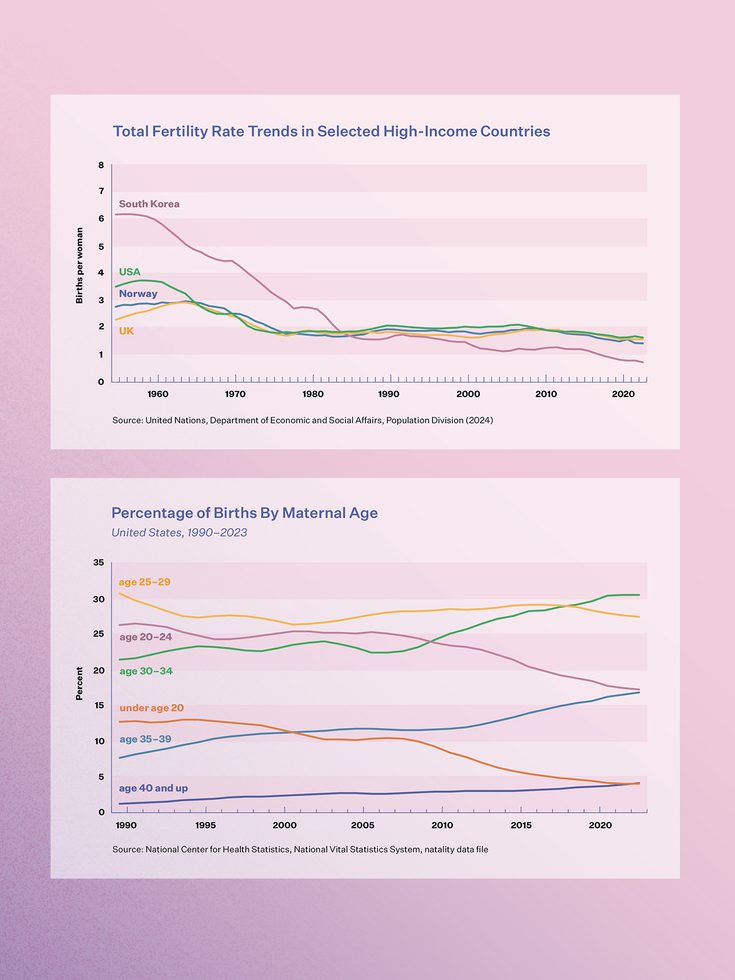
Total fertility trend charts enlarged
Does Gen Z want kids?
Gen Z, the generation in college now, appears to be living through another shift. In surveys, a growing number of young women indicate little desire to ever have kids.
Sari Pekkala Kerr, an economist and senior research scientist at the Wellesley Centers for Women, teaches a women in the economy course annually. She begins the semester by asking students to raise their hands if they see themselves getting married one day and having kids. Last fall, 60% indicated that they think they wanted to get married, but only 25% would consider having children. Even Kerr was stunned. It was a significant decline compared to a decade ago.
“It’s never been that low before. Many students aren’t even thinking about having kids as part of the big picture of life,” says Kerr. “My students now think more about lifestyle. They want to travel and retire younger. They believe ‘having it all’ is an impossible myth.”
For Simone Beauchamp ’26, an English and creative writing major, getting married and having kids has never interested her. When we spoke, she expressed moral qualms about having kids.
“I have a hard time rationalizing bringing children into a world that I just don’t love the trajectory of. We’re not headed in a good direction,” Beauchamp says, citing both political and climate change concerns.
More women are child-free or having kids after 35
It’s possible many Gen Z women will never have kids, but they also might end up having them later in life. There’s been an incredible rise in births to women over 35. Advances in egg freezing and in vitro fertilization (IVF) have enabled more women to give birth later in life. After I gave birth in the Washington, D.C., area at age 40, I asked my doctor the age of the oldest woman she had helped. A week prior, she had delivered a healthy baby to a 50-year-old woman.
Betsey Stevenson ’93, a former chief economist at the U.S. Department of Labor and current professor of public policy and economics at the University of Michigan, says a key statistic to focus on is “completed fertility,” which measures whether women have given birth by the end of their childbearing years. This metric hasn’t moved as much as people think.
In 1980, 10% of women aged 40 to 44 in the U.S. had never given birth. That number rose steadily to 20% by 2006, U.S. Census data show. But then something interesting happened: The rate started dropping back down. The latest data show 15% of American women were childless by age 50 in 2024. It’s true there are millions more childless women in the U.S. versus a few decades ago. Some intend to remain child-free, but other women are waiting until later in life to have kids.
Bailey Childers ’05 knew early on that she didn’t want kids. Her first year at Wellesley, she and her Dower dormmates had many late-night discussions about their intention to live a child-free life. Their end-of-year scrapbook even included “Mommy no!” jokes. To this day, none of them has had a kid.
“I feel very happy about my life,” Childers says. “You don’t have to have children to be fully engaged in society. I volunteer. I help with an animal rescue for cats and dogs. I’m productive at work. I’ve been part of some big policy changes in this country throughout my career. There are plenty of ways to give back.”
People used to tell her she would change her mind, but even her mom has stopped commenting. She’s noticed more acceptance of child-free life in recent years as terms such as DINK (double income, no kids) and SINK (single income, no kids) have become popular.
Many students aren’t even thinking about having kids as part of the big picture of life. My students now think more about lifestyle. They want to travel and retire younger. They believe ‘having it all’ is an impossible myth.”
The one-child family
Another big cultural shift is the rise of the one-child family. Today nearly 20% of U.S. families have an only child, up from 10% in 1980. Costs came up repeatedly as alums discussed their deliberations over whether to have a second child.
Hannah Braaten Yanakiev ’11 lives in New York City and works in publishing. After a grim experience on the dating scene, she met her husband in her early 30s and was pleasantly surprised that when they first met he said he wanted a family and was dating to find a wife. They married, and Yanakiev gave birth at age 34 to their daughter. They both love being parents, but they are fairly sure they are “one and done” as they try to make life work in a 690-square-foot apartment with $3,200 a month in day care expenses.
“I can’t really see a path to have a second baby unless one of us hits the lottery,” Yanakiev says, though they might reconsider if newly elected New York Mayor Zohran Mamdani succeeds in implementing subsidized day care.
Several alums say having three kids has become a sign of wealth in major cities. But even in Cleveland, one of America’s most affordable cities, the math feels different for two kids—both the costs and the lifestyle shift.
Julia Aromatorio ’13 married her high school sweetheart and they settled in Cleveland, not far from where they grew up in Youngstown, Ohio. She gave birth at age 29 to a daughter, making her one of the youngest moms in the preschool pickup line. The couple briefly contemplated having another child, but felt “very solidly one and done” after their daughter turned 4. They have little desire to start over with diapers and sleepless nights again.
“We’re lucky to be in a position where finances are not the limiting factor. It’s more just lifestyle,” Aromatorio says. “Now that she’s older, we can travel a ton. We go out to eat and do activities.”

Fertility 101
Fertility issues are another common barrier many alums have faced as they try to have children. Rosanna Hertz, the Class of 1919–50th Reunion Professor of Sociology and Women’s and Gender Studies, landed in the hospital with severe endometriosis. The doctor told her she might never be able to have children. Fortunately, she was able to give birth to her daughter, but it was a long and arduous journey. She advocates for every state to mandate fertility coverage so these options aren’t limited to those who can afford them. Her years researching single moms by choice and the fertility industry revealed the financial and fertility barriers that so many women still face.
“Becoming a mother took me longer than it did to get a Ph.D.,” Hertz says. “When you go through fertility treatments, you’re relieved to have one child.”
Catherine Lee ’08 got engaged while she was at Wellesley. The reaction to her engagement on campus was shock and some hostility. Several professors tried to talk her out of it, encouraging her to wait longer before committing.
Lee is one of many alums interviewed for this article who wish there were a lot more discussion at Wellesley—and in society—about the basics of fertility and the health issues to watch for. She was glad she participated in Management Basics, a business boot camp the College ran before its current Upskill immersive experiential learning programs, during Wintersession in 2008. It turned out to be the only time she talked about fertility during her college years.
Katherine Collins ’90, a pioneer of sustainable investing, was a guest speaker that January. Collins drew a line on the chalkboard that was mostly flat and then went down sharply. She asked the Wellesley students to guess what it was. Many guessed earnings or profits or climate impact. Collins told the room it was women’s fertility, which declines swiftly after 35.
“I was about 40 when I gave that talk. I wanted to make sure anyone who was 20 years old and thinking about what they might want in their life over the long term knew this was a fact,” Collins told me.
Liany Arroyo ’98 says the only time she recalled talking about fertility in college was “people trying to buy our eggs with ads in the Wellesley News. I didn’t qualify because I was of Latina descent and didn’t have the SAT scores they wanted.”
Arroyo married at 30 but wasn’t able to have her first child until she was 35; she had her second at 40. She and her husband initially wanted three kids, but fertility struggles altered their plans.
“Fertility is finite. It doesn’t wait for anyone,” Arroyo says. “We’re lucky to have options now, but it’s not a guarantee. It’s important for young women and men to know that.”
The role of policy
All of these complexities make it difficult to come up with policies that can reverse—or even slow down—fertility decline. Americans talk about the urgent need to support parents. The U.S. still doesn’t require paid parental leave, and there’s little subsidized child care. New Mexico just became the first state to launch no-cost child care, a test case for what might be possible nationwide.
But fertility is declining even in Scandinavian countries that are global leaders in providing support for parents. Money and child care make life better for families, but these policies alone aren’t enough to reverse the trend. It will take another shift in priorities for teens and college students to even desire to have a kid before 30, which greatly enhances the likelihood of having more than one, says Levine, the Wellesley economics professor.
Social media personalities known as “tradwives,” short for traditional wives, are trying to make early marriage and motherhood desirable again. But current Wellesley students say they view the portrayal of family life from tradwives or on shows such as The Secret Lives of Mormon Wives as a mockery, not a model to follow.
Ultimately, the phrase that came up repeatedly as I spoke to alums was being “at peace” with how life turned out. They wished they had known more about fertility challenges in their 20s, but life turned out as it was meant to be.
As I tried to edit this story with my own toddler running around, I felt the same way. I’m glad to live in an era when I could use IVF to have a child as a solo mom at age 40. I’m also optimistic that if technology and society could advance in the coming decades, then solutions for this “crisis” will emerge that won’t involve forcing women to be tradwives again.
Heather Long ’04 is chief economist at Navy Federal Credit Union, a former journalist at The Washington Post and CNN, and a single mom.


Post a Comment
We ask that those who engage in Wellesley magazine's online community act with honesty, integrity, and respect. (Remember the honor code, alums?) We reserve the right to remove comments by impersonators or comments that are not civil and relevant to the subject at hand. By posting here, you are permitting Wellesley magazine to edit and republish your comment in all media. Please remember that all posts are public.